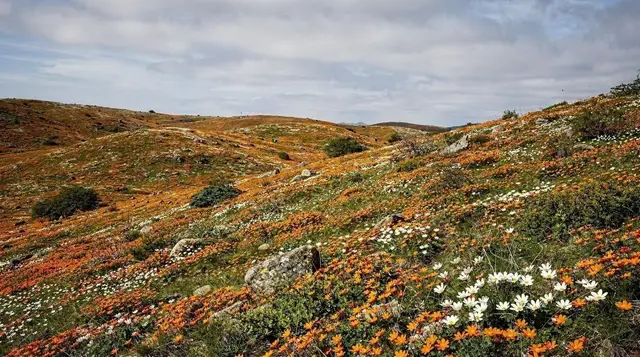
Fynbos and the Cape Floral Kingdom
What exactly is fynbos, and why is it a big deal?
Fynbos is the fine-leafed shrubland that dominates the Cape Floral Kingdom, the smallest of the world's six floral kingdoms and, remarkably, one of the most biodiverse per square kilometre anywhere on Earth — a UNESCO World Heritage site for exactly that reason. Its three defining plant families are proteas, ericas (heaths) and restios (Cape reeds), and much of it is fire-adapted, meaning many species actually need periodic fire to regenerate and reproduce.
Most visitors to Cape Town walk through fynbos without knowing its name — it’s the low, fine-leafed shrubland covering Table Mountain’s slopes, much of the Cape Peninsula, and stretches of the Winelands and coast beyond. It’s also one of the most botanically significant plant communities on the planet, and understanding even the basics changes how the whole region reads on foot.
| What it is | Fine-leafed shrubland dominant across the Cape Floral Kingdom |
| Where to see it | Table Mountain’s slopes, Cape Point, Kirstenbosch’s upper sections, and Winelands nature reserves |
| Key plant families | Proteas, ericas (heaths), restios (Cape reeds) |
| Status | Cape Floral Kingdom is a UNESCO World Heritage site |
| Notable trait | Many species are fire-adapted and need periodic burning to regenerate |
What fynbos actually is
Fynbos — Afrikaans/Dutch for “fine bush,” a reference to the narrow, fine-textured leaves typical of the plant community — is a shrubland ecosystem built around three dominant plant families: proteas, which include the flamboyant, large-flowered species most visitors recognise on sight; ericas, a vast genus of heaths with small, often tubular flowers; and restios, reed-like plants that form much of the ecosystem’s structural backbone even though they’re far less conspicuous than the flowering species. Together they make up an ecosystem that looks superficially modest — low, scrubby, unglamorous at a glance — but is extraordinarily rich in species diversity once you look closely.
Why the Cape Floral Kingdom matters globally
The Cape Floral Kingdom is the smallest of the world’s six recognised floral kingdoms — a scientific classification of the planet’s major distinct plant regions — and yet holds a genuinely remarkable concentration of plant species relative to its size, with many found nowhere else on Earth. This combination of small area and exceptional biodiversity is exactly why UNESCO lists it as a World Heritage site, putting it in the same tier of global significance as far larger, more famous ecosystems.
For a traveller, the practical takeaway is that a walk through fynbos on Table Mountain or in a Winelands nature reserve isn’t simply “some plants” — it’s a walk through one of the most concentrated pockets of plant diversity on the planet, even if the individual flowers are often smaller and less immediately dramatic than a tropical rainforest’s.
Fire: the ecosystem’s strange requirement
One of fynbos’s more counterintuitive traits is its relationship with fire. Many species have evolved specifically around periodic burning — some seeds require the heat or chemical compounds from fire smoke to trigger germination at all, and fire clears out dominant, older growth that would otherwise crowd out a wider range of species over time. This means fire suppression, which might intuitively seem like ecosystem protection, can actually reduce fynbos biodiversity over the long run by preventing the natural cycle the ecosystem depends on. Land managers around Cape Town generally work with this reality through controlled, managed burns rather than blanket fire prevention.
Where to see fynbos around Cape Town
Table Mountain’s lower and middle slopes are covered extensively in fynbos, visible on virtually any hike or cable car trip up the mountain without requiring a dedicated fynbos-focused outing. Kirstenbosch’s more naturalistic upper sections blend cultivated garden into genuine fynbos habitat, and the trailhead for this guided Skeleton Gorge hike moves directly from the cultivated garden into that wilder terrain, a good option for seeing the transition on a single outing.
Further into the Winelands, several nature reserves protect substantial fynbos habitat away from the more heavily visited Table Mountain routes. This Leopard’s Loop hike in Helderberg Nature Reserve and this guided Panorama Trail hike in Jonkershoek Nature Reserve both offer genuine fynbos hiking in quieter settings than the Peninsula’s more popular trails.
Fynbos versus West Coast wildflowers
It’s worth distinguishing fynbos from the seasonal wildflower displays further north along the West Coast, since visitors sometimes conflate the two. West Coast wildflowers are largely annual and bulb species responding to winter and early spring rainfall, producing a dramatic but narrow, weather-dependent bloom concentrated in a short window. Fynbos, by contrast, is a permanent shrubland ecosystem with flowering patterns spread more broadly through the year and across a much wider geographic range — you don’t need a specific rainy season to see fynbos in flower, unlike the West Coast display. This wildflower trails hiking tour is a reasonable way to see both ecosystems on the same trip if timing allows.
Betty’s Bay and coastal fynbos
Fynbos extends well beyond the Peninsula and Winelands into coastal reserves along the Whale Coast. This guided hike at Betty’s Bay’s Harold Porter Botanical Garden combines fynbos habitat with coastal scenery, worth considering if a Whale Coast day trip already has some flexibility built in.
Frequently asked questions about Fynbos and the Cape Floral Kingdom
Where can I see fynbos near Cape Town without a dedicated hike?
Table Mountain’s lower slopes, Kirstenbosch’s more naturalistic upper sections, and Cape Point within the Table Mountain National Park all offer accessible fynbos viewing without requiring a serious hike.
Why does fynbos need fire to survive?
Many fynbos species have evolved fire-dependent reproduction strategies — some seeds only germinate after exposure to fire-related heat or smoke compounds, and periodic burning clears out dominant older growth, allowing a wider range of species to regenerate. Fire suppression, ironically, can reduce fynbos biodiversity over time rather than protect it.
What’s the difference between fynbos and the wildflowers on the West Coast?
They’re related but distinct — West Coast wildflower displays are largely seasonal annual and bulb flowers responding to winter rain, concentrated in a narrow spring window, while fynbos is a permanent shrubland ecosystem with its own flowering patterns spread more broadly across the year and the Cape Floral Kingdom’s wider range.
Do I need a guide to appreciate fynbos, or can I just walk through it?
You can absolutely walk through it independently and enjoy the scenery, but a guide or naturalist-led walk adds real context — most visitors can’t distinguish a protea from an erica from a restio without some pointers, and knowing what you’re looking at meaningfully changes the experience.
tours.gardens-nature
Verified deep-linked GetYourGuide tours. Book through these links and we earn a small commission at no cost to you.
Photos show the destination, not the operator's own images.