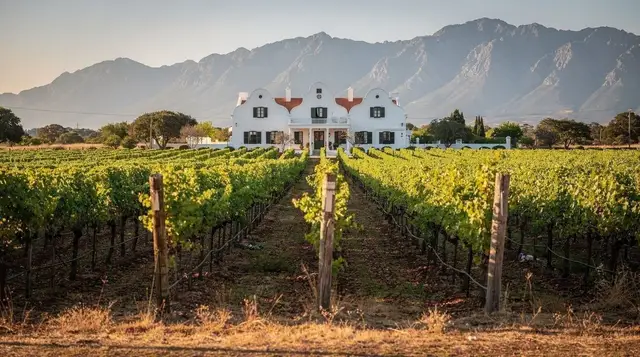
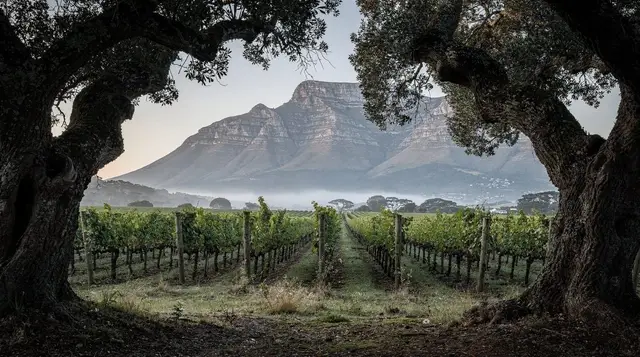
Stellenbosch gets treated as a wine-tasting stopover by a lot of itineraries, and that undersells the town itself. Founded in 1679 by Simon van der Stel, it’s South Africa’s second-oldest settlement after Cape Town, and its historic core — oak-shaded streets, whitewashed Cape Dutch gables, a university town’s steady buzz of cafés and bookshops — is worth a slow afternoon on its own, separate from whichever wine farm is next on the list.
| Where | Winelands, roughly 45 minutes’ drive from Cape Town CBD |
| Time needed | Full day for town plus a couple of estates; 2 nights for a proper Winelands base |
| Getting there | Self-drive is easiest given the spread-out estates; guided tours handle the driving (and the tasting) for you |
| Cost | Free to walk the town; tasting fees vary by estate and are usually waived with a purchase — check current rates directly with each farm |
| Best time | Year-round; February-April brings harvest activity to the cellars |
The historic centre: Dorp Street and the Braak
Dorp Street is one of the best-preserved historic streets in South Africa, its Cape Dutch and Cape Georgian façades dating largely from the eighteenth and nineteenth centuries — a rebuilt streetscape after fires, rather than an untouched original, but a genuinely handsome one either way. Walking it slowly, rather than driving through on the way to a wine farm, is the whole point.
The Braak, the old village green near the centre, anchors a cluster of the town’s oldest buildings, including a Rhenish mission church and the Burgher House. None of this requires a ticket or a booking — it’s a free, self-directed hour or two, best combined with a coffee stop at one of the cafés spilling onto the surrounding streets.
Stellenbosch University, one of South Africa’s oldest and most prestigious, gives the town its particular character: a student population that keeps the bars and bookshops busy without tipping the centre into the kind of purely tourist-facing strip that some Winelands towns have become.
Why Pinotage matters here specifically
South Africa’s signature red grape, Pinotage, was bred at Stellenbosch University in 1925 — a cross of Pinot Noir and Cinsaut (then known locally as Hermitage, hence the name). It’s a genuinely divisive grape even among South African wine drinkers: some estates coax smoky, plum-driven complexity out of it, others produce something closer to rubbery and over-extracted, and which camp a given bottle falls into depends heavily on the producer. Stellenbosch is the place to actually compare a few side by side rather than take anyone’s word for it, since so many of the grape’s benchmark examples come from estates in this valley.
A guided Pinotage-focused tasting tour is a practical way to do that comparison without driving yourself between farms and then having to taste responsibly.
Getting between the estates
Stellenbosch’s wine farms are spread widely enough that walking between them isn’t realistic for most visitors — some are a short drive from the town centre, others considerably further out toward Helshoogte or the Bottelary Hills. Three practical options: self-drive with a nominated non-tasting driver, a guided minibus tour that plans the route and the tasting order, or the Stellenbosch hop-on hop-off tractor-and-trailer circuit, a slower, more novel way to move between a fixed set of participating farms without arranging your own transport between each stop.
The Stellenbosch hop-on hop-off tractor wine tour suits travellers who want to set their own pace at each stop rather than follow a guide’s schedule.
Stellenbosch versus Franschhoek: which one first
Both towns anchor the Winelands, and most multi-day visitors do both, but they’re not interchangeable. Stellenbosch has the larger, older town centre and a wider spread of estate styles, from big commercial producers to small boutique cellars; Franschhoek is smaller, more concentrated, and leans harder into its French Huguenot history and its food-and-wine pairing culture. If only one fits the schedule, Stellenbosch’s mix of history and wine variety makes it the stronger single stop; Franschhoek rewards a dedicated half-day if the Wine Tram itself is the draw.
A tour that covers both in one day exists for travellers who can’t choose:
the full-day Stellenbosch and Franschhoek wine tour, though be honest with yourself about pace — covering two wine towns properly in one day means fewer tastings at each, not a shortcut to seeing everything.
Beyond wine: Jonkershoek
For travellers who want a break from tasting rooms, Jonkershoek Nature Reserve, a short drive from the town centre, offers mountain trails through fynbos and forested kloofs with genuinely good views back over the valley. It’s a legitimate half-day alternative to another cellar visit, and a useful one if a member of the group isn’t drinking.
A guided hike on Jonkershoek’s Panorama Trail covers the route with someone who knows the terrain, useful given how quickly Western Cape weather can change on exposed mountain paths.
What isn’t worth the detour
Some of the estates closest to town, and easiest to reach without a car, lean heavily into bus-tour volume — large tasting rooms processing groups quickly, with less individual attention than a smaller boutique cellar further out would give. If unhurried conversation with the person actually making the wine matters to you, it’s worth asking a guide (or researching in advance) which estates on a given tour route are geared that way, rather than assuming proximity to town means quality.
A realistic day in Stellenbosch
A comfortable day covers the historic centre in the morning — Dorp Street, the Braak, a museum or two — followed by two, at most three, estate visits in the afternoon. Trying to fit in more tastings than that usually means rushing both the town and the wine, and rushing a wine tasting largely defeats the point of it. If staying overnight, push one estate visit to the following morning instead, before the day’s heat sets in.
Getting there and around
Self-driving from Cape Town takes roughly 45 minutes via the N1 and R310, traffic depending — the M12 through Table Mountain National Park’s edge is a scenic but slower alternative. The Metrorail Southern Line does run to Stellenbosch, but service reliability has varied significantly in recent years; check the current status directly before planning around it rather than assuming a timetable that may no longer hold. Most day-trippers either self-drive or book a tour that includes transport, which removes the driving-and-tasting conflict entirely.
How this fits into a longer trip
Stellenbosch pairs naturally with Franschhoek as a two-town Winelands day, or with Paarl and Wellington for a wider loop through the valley. Travellers building a broader Western Cape itinerary often set Stellenbosch as a base for one or two nights before continuing on to the Whale Coast or back to Cape Town itself.