Table Mountain cableway guide
Is the Table Mountain cableway worth it, or should I hike instead?
For most visitors, yes — it's the fastest and least strenuous way to reach a plateau most people would otherwise need several hours of steep hiking to see, and the rotating cabin gives a 360-degree view of the city, the Atlantic seaboard and the peninsula on the way up. The one real catch is weather: the cableway closes for high wind, low cloud, or annual maintenance, so it rewards flexibility over a fixed single-day plan.
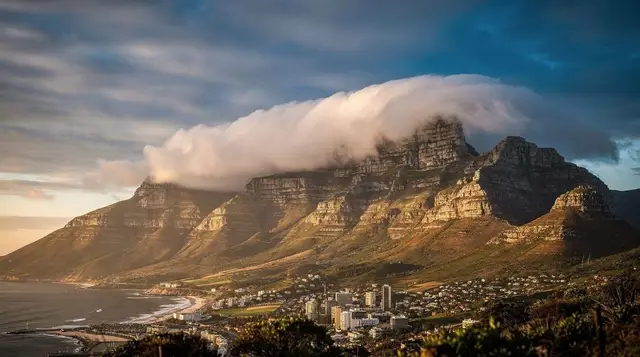
The Table Mountain cableway is the single most efficient way to stand on top of Cape Town’s defining landmark, and for a flat-topped sandstone mountain whose summit sits a little over 1,000 metres above the city, that matters. No other viewpoint in Cape Town delivers the same combination of height, openness and ease. But the cableway is also the part of a Table Mountain day most likely to go sideways, because it depends entirely on weather that the mountain itself generates. Here’s what actually happens on the way up, and the one habit that saves a wasted trip.
| Where | Lower Cable Station, Tafelberg Road, above the City Bowl |
| Getting there | Short taxi or rideshare from the City Bowl; limited on-site parking |
| Time needed | A few minutes each way in the cabin; allow extra for queuing at busy times |
| Weather dependency | Closes for high wind, low cloud cover, and an annual maintenance shutdown |
| Best time | Early morning for calmer wind and shorter queues, before midday crowds build |
How the cableway actually works
The cableway runs between the Lower Cable Station on Tafelberg Road and the Upper Cable Station on the plateau itself, and the ride is short — a matter of minutes rather than a scenic crawl. What makes it distinctive is the rotating cabin floor: rather than everyone crowding toward one side for a view, the floor turns slowly during the ascent, giving every passenger a full circuit of the City Bowl, Lion’s Head, Robben Island out in Table Bay, and the Atlantic seaboard falling away below. It’s genuinely one of the better few minutes of any Cape Town itinerary, and it’s worth positioning yourself near the centre of the cabin rather than pressed against the glass, since the rotation does the work for you.
Table Mountain cableway ticket is the standard way to book, and doing so ahead of a visit avoids arriving at the Lower Cable Station only to find the day’s allocation full.
Why it closes, and why that’s not a design flaw
Table Mountain’s plateau is exposed on every side, and the same wind that gives the mountain its famous cloud “tablecloth” also makes cable travel unsafe past a certain point. The operator suspends the cableway when wind speeds pass a safety threshold, when cloud drops visibility too low at the top, or for a scheduled annual maintenance period — typically lasting a couple of weeks and announced well in advance. None of this is arbitrary caution: a mountain that generates its own weather system, independent of what the rest of Cape Town is experiencing at sea level, will close a wind-exposed cable system more often than a typical city attraction.
The practical consequence is that a Table Mountain day should never be the single fixed anchor of a tightly scheduled itinerary. Build in a spare day, or at minimum a flexible morning, particularly if you’re visiting during the windier summer months when the south-easter blows hardest.
The one check that saves the trip
Before queuing, before booking transport, before anything else: check the cableway’s live operating status for that specific day, on the morning you plan to go up. A clear sky over the City Bowl doesn’t guarantee calm conditions on the plateau a thousand metres above it — the two can diverge sharply, and cloud or wind can build through the morning even when the day starts fine. Checking status on arrival, rather than relying on a forecast from the night before, is the single habit that separates a smooth cableway visit from a wasted half-day.
Table Mountain cableway and hop-on hop-off combo ticket is worth considering if you’re pairing the summit with a wider day of city sightseeing, since it bundles transport logistics into one booking.
Queues, crowds, and when to go
The ride itself takes only a few minutes, but the queue to board can run considerably longer at peak times — midday, weekends, and the busiest weeks of the southern hemisphere summer all push waiting times up. An early-morning visit, ideally at or near opening, tends to combine the calmest wind of the day with the shortest queue, since both wind and crowds typically build through the late morning. A pre-booked, timed ticket also helps, letting you skip the walk-up queue at the base station.
Skip-the-line Table Mountain cable car ticket is aimed specifically at cutting that base-station wait, useful if your schedule for the day is tight.
Hike up, cable down — or the reverse
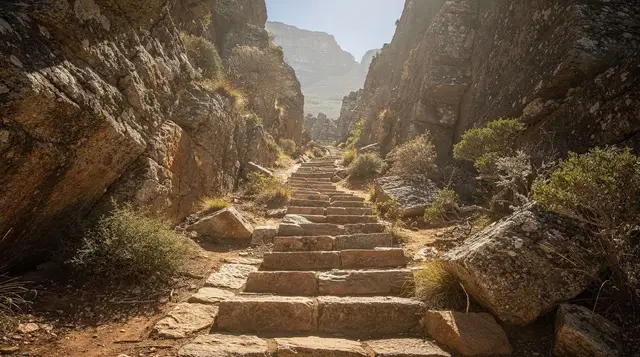
A genuinely popular way to experience both the mountain’s terrain and the cableway’s view is to combine them: hike up via one of the plateau’s access routes, most commonly Platteklip Gorge, and ride the cableway back down, sparing your knees the steep descent while still earning the summit on foot. The reverse — cableway up, hike down — also works, and suits visitors who want the guaranteed summit view first before deciding whether they have the legs and time for a walking descent. Either way, a one-way cableway ticket is what you want rather than a round trip, so it’s worth checking that option specifically when booking.
What’s actually on the plateau
The summit isn’t a single viewpoint but a genuine plateau, with walking paths, several marked lookout points, a café, and — weather permitting — long views stretching from the Twelve Apostles range along the Atlantic seaboard to Robben Island and the Hottentots-Holland mountains inland. Rock hyraxes (locally called dassies), small mammals distantly related to elephants, are a near-constant presence around the paths and worth watching from a respectful distance rather than approaching or feeding.
Table Mountain cable car experience with reserved tickets includes guided orientation for visitors who’d rather have context for what they’re looking at than wander the plateau unguided.
What can genuinely go wrong
The most common disappointment isn’t a cancelled trip but a hazy one: cloud cover that doesn’t fully close the cableway but does flatten the view, leaving visitors at the top with a grey, low-visibility panorama rather than the postcard shot. There’s no way to guarantee against this beyond checking conditions closely and, if your schedule allows, treating a first hazy attempt as a reason to try again on a clearer day rather than a wasted trip.
tours.table-mountain
Verified deep-linked GetYourGuide tours. Book through these links and we earn a small commission at no cost to you.
Photos show the destination, not the operator's own images.