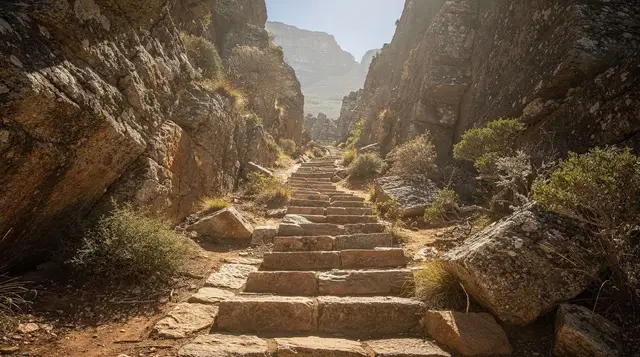
Lion's Head hike and full-moon walks
Is Lion's Head harder or easier than climbing Table Mountain?
Generally considered more approachable in overall time and distance than a full Table Mountain summit hike, but not easier in every sense — the upper sections involve chains and metal ladder rungs bolted into the rock, with genuine exposure, which some hikers find more intimidating than a straightforward steep gorge like Platteklip. A short, easier bypass path around the chain sections exists for hikers who'd rather skip the scrambling.
Lion’s Head is the peak most Capetonians actually hike regularly, not just the one visitors photograph from a distance. Its spiral trail, chain-assisted upper section, and near-360-degree summit view have made it a genuine local institution, most visibly through the monthly full-moon hike tradition that turns an ordinary Tuesday evening into a trail full of headlamps. Here’s what the climb involves and how to time it right.
| Where | Between Table Mountain and Signal Hill, above Camps Bay and Sea Point |
| Trail character | Spiral path around the peak, with chains and metal ladder rungs near the top |
| Time needed | A few hours round trip at a comfortable pace, less for fast hikers |
| Best time | Sunrise, sunset, or the evening of the full moon |
| What to bring | A headlamp for any dusk or after-dark hike, plus water and proper footwear |
Why Lion’s Head draws such a crowd
Unlike a straight climb to a single summit, the Lion’s Head trail winds around the peak in a spiral, offering a constantly shifting view — the Atlantic seaboard, the City Bowl, Table Mountain’s Back Table and Robben Island all rotate into view at different points on the way up. That variety, combined with a genuinely manageable overall time commitment compared with a full Table Mountain ascent, makes it the hike locals return to again and again rather than treating as a one-off tourist stop.
Lion’s Head sunset hike is the classic way to experience it, timed so the summit view coincides with the sky turning colour over the Atlantic.
The chains and ladder section
Near the top, the trail’s character changes: sections of exposed rock are fitted with chains to hold and short metal ladder rungs bolted into the rockface, letting hikers pull themselves up steeper pitches that would otherwise require technical climbing. These sections demand steady footing and a reasonable comfort with exposure — they’re not long, but they’re the part of the hike that separates Lion’s Head from a simple uphill walk. A bypass path exists for hikers who’d rather avoid the chains altogether, looping around the steepest scrambling without reaching the exact summit by the direct route.
Lion’s Head sunrise or sunset hike is worth booking guided if the chain sections are your first experience of that kind of scrambling — a guide who knows the route removes a lot of the uncertainty.
The full-moon hike tradition
Once a month, on the evening of the full moon, Lion’s Head becomes something closer to a local event than a routine hike. Hundreds of Capetonians and visitors climb together in the fading light, reaching the summit around moonrise to watch the moon come up over the city and the mountains, then descend by headlamp under moonlight. It’s a genuinely social tradition — strangers chat on the trail, and the atmosphere at the top on a clear full-moon evening is unlike an ordinary hike. If your visit coincides with a full moon, it’s worth building an evening around.
Guided sunset or sunrise Lion’s Head hike with pickup takes the logistics out of joining a full-moon or sunset climb, particularly useful if you don’t have your own transport back down after dark.
Why a headlamp is non-negotiable after dark
Moonlight, even on a genuinely clear full-moon night, is not sufficient on its own to safely navigate the rocky trail and chain sections on the way down. A proper headlamp — not a phone torch held in one hand — is the standard piece of kit for any dusk or after-dark Lion’s Head hike, and it matters more here than on most Cape Town trails specifically because of the chain-and-ladder sections, where you need both hands free. Pack one even if you’re planning a straightforward sunset hike; descents routinely run later than expected once everyone stops for photos at the top.
Sunrise versus sunset
Both are popular, and the choice comes down to preference and crowd tolerance more than any objective difference in the hike itself. Sunset draws bigger numbers overall, particularly on weekends, while sunrise hikes tend to be quieter and reward early risers with cooler temperatures for the climb. Either way, allow enough time to reach the summit with a comfortable margin before the light show actually starts — rushing the final stretch to beat sunset defeats the purpose of the hike.
Lion’s Head guided tour, sunrise or sunset handles the timing calculation for you, aiming to have the group at the top with time to spare before the light changes.
Safety on a heavily used trail
Lion’s Head is one of the busiest trails on the peninsula, especially around sunrise, sunset and the full moon, which in practice makes it one of the least isolated hikes in the city. That said, the general safety advice for Cape Town’s mountain trails still holds: hike with others rather than alone where possible, stay on the main marked path, and don’t leave valuables visible in a parked car at the trailhead. Fog and sudden wind can still roll in quickly even on a well-used trail, so check conditions before setting off, particularly for an after-dark hike where visibility already matters more.
Lion’s Head hike with picnic is a relaxed alternative for anyone who wants the summit view without rushing straight back down — worth considering for a slower, more social evening on the mountain.
What to wear and carry
Grippy, closed hiking shoes matter more on Lion’s Head than the overall hike length might suggest, particularly for the chain-and-ladder section where sure footing on rock makes a real difference to confidence. Gloves are a small addition worth carrying even outside the cooler months, since gripping metal chains and rungs is noticeably easier and more comfortable with some hand protection. A light jacket is worth having for the summit regardless of how warm the walk up felt, since wind picks up noticeably at the top and temperatures drop once the sun starts setting on an evening hike. And for anyone doing a sunrise or full-moon hike, pack the headlamp before you leave rather than assuming you’ll manage with a phone torch — fumbling for light with both hands needed on the chains is exactly the situation you want to avoid.
tours.table-mountain
Verified deep-linked GetYourGuide tours. Book through these links and we earn a small commission at no cost to you.
Photos show the destination, not the operator's own images.