Platteklip Gorge: the direct route up
How hard is the Platteklip Gorge hike?
It's a genuinely demanding climb, not a gentle walk — a steep, sustained gradient with no flat sections and no shade cover anywhere on the route, taking several hours round trip depending on fitness and pace. It requires no scrambling or technical skill, which is what makes it the most accessible route to the summit, but underestimating the sun and gradient is the most common way people struggle on it.
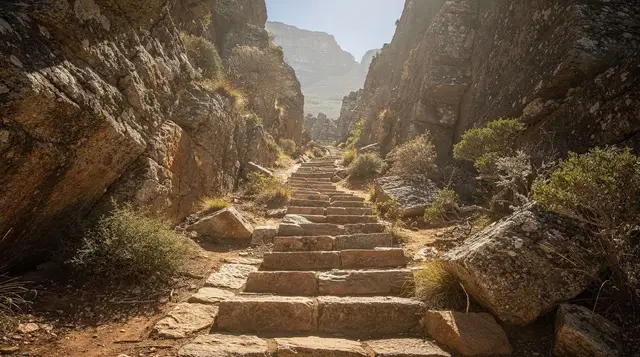
Platteklip Gorge is Table Mountain’s most direct route to the top, and “direct” is the operative word: it’s a straight, steep gorge from the City Bowl’s edge to the plateau, with no navigation decisions to make and no shade to hide in along the way. It’s the route most first-time hikers choose, and for good reason — but going in without realising how relentless it is catches plenty of people out.
| Where | City Bowl side of Table Mountain, trailhead above central Cape Town |
| Character | A single, steep, well-marked gorge — no route-finding required |
| Shade | None — the route is fully exposed to the sun throughout |
| Time needed | Several hours round trip, depending on fitness and pace |
| Getting down | Most hikers combine the climb with a cableway descent |
Why Platteklip Gorge is the default choice
Of all the routes to Table Mountain’s summit, Platteklip Gorge is the one most visitors end up on, largely because it’s the closest trailhead to central Cape Town and the simplest to navigate — a single gorge running more or less straight up, with no branching paths to second-guess. That directness is genuinely useful for a first attempt: there’s little chance of getting lost, and the route is popular enough that you’re rarely walking in isolation. See the Table Mountain hiking routes comparison for how it stacks up against Skeleton Gorge and India Venster if you’re still deciding.
Table Mountain Platteklip Gorge hike is worth booking as a guided climb if it’s your first attempt and you’d rather have someone set a sensible pace and point out where to rest.
What the climb actually feels like
This is not a gentle walk with occasional steep bits — it’s steep for essentially its entire length, following a route of stone steps and rocky path that gains height quickly and doesn’t let up until you’re near the top. There are no long flat stretches to recover on, which means pacing matters more here than on almost any other Cape Town hike. Most hikers who struggle on Platteklip Gorge aren’t unfit in general terms; they simply set off too fast for a climb with no natural rest points built into the terrain.
Budget several hours for the round trip, and treat any time estimate as a guide rather than a target — the honest approach is to walk at a pace you can sustain rather than chase a number.
The sun is the real challenge, not the gradient
Ask anyone who’s done this hike what they’d change, and most say the same thing: more water, more sun protection, an earlier start. The gorge has no tree cover anywhere along its length, which means on a hot, still morning the exposure compounds the physical effort of the climb itself. A hat, high-factor sunscreen reapplied during the hike, and considerably more water than feels necessary at the trailhead are not optional extras here — they’re the difference between a hard but manageable climb and a genuinely miserable one.
Table Mountain group hike via Platteklip Gorge is a practical way to tackle it with company and a guide who knows to pace the group around the exposure rather than push straight through it.
Timing your climb around the weather
Table Mountain generates its own weather independent of what’s happening at sea level in the rest of Cape Town, and Platteklip Gorge’s total exposure means wind and heat both hit harder here than on a shaded route. An early start — aiming to be on the trail before the day’s heat and wind build — is the single best piece of timing advice for this specific hike. If cloud is closing in or wind is picking up as you climb, treat that as a genuine signal to reconsider rather than push on; see the Table Mountain safety guide for how quickly conditions here can shift.
Table Mountain guided hike tour is a sound option if you’d rather have someone monitoring conditions and making the call on pace or turning back, rather than judging it entirely yourself on a first visit.
Getting down: cableway or the same way back
The overwhelming majority of Platteklip Gorge hikers ride the cableway down rather than retrace the steep descent on foot, which spares the knees a punishing downhill on loose stone steps. This only works if the cableway is actually running that day, so check its live operating status before you set off — see the Table Mountain cableway guide for why it closes and how to check. If it’s not running, or you’d simply rather walk down, budget real time and care for the descent: steep loose stone underfoot is harder on balance and joints going down than climbing up.
Table Mountain hike with a guide covers the full up-and-down experience for hikers who’d rather not manage the cableway logistics or a solo descent themselves.
Who should think twice
Platteklip Gorge requires no scrambling or technical skill, but it does require sustained cardiovascular fitness and comfort walking steadily uphill for an extended period with no breaks in the gradient. Anyone with knee or joint concerns should think carefully about the descent in particular, whether on foot or via the inherently jarring transition into a queue at the cableway’s base station. Families with young children should read this as a genuinely demanding hike for small legs, not a casual outing — see the Table Mountain hiking routes comparison for gentler alternatives.
What to pack specifically for this route
Because Platteklip Gorge’s defining challenge is sun exposure rather than technical difficulty, packing choices matter more here than the gear list for a typical hike. A wide-brimmed hat does more good than a cap, since the sun tracks across the gorge for most of the climb rather than staying at a single angle. Electrolyte tablets or a similar addition to your water are worth considering on a hot day, given how much you’ll sweat on a sustained steep climb with no shade to cool off in. A lightweight, breathable long-sleeve layer can work better than bare skin under strong sun, provided it’s not so warm it adds to the heat burden. And because most hikers plan to ride the cableway down, keep a change of footwear or at least dry socks in a day bag if you’re continuing on to other sightseeing afterwards — a sweat-soaked hike leaves most people wanting a change before the rest of the day.
tours.table-mountain
Verified deep-linked GetYourGuide tours. Book through these links and we earn a small commission at no cost to you.
Photos show the destination, not the operator's own images.