Reading Table Mountain's weather
What is Table Mountain's 'tablecloth' cloud?
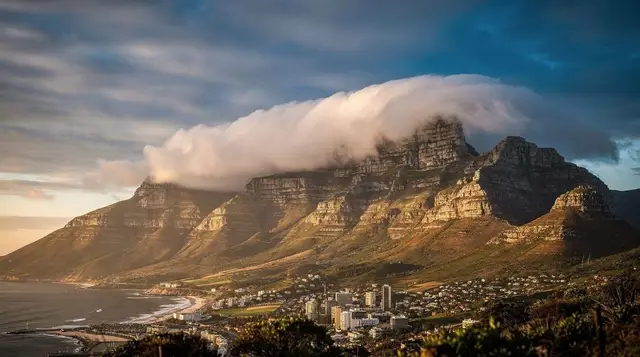
A thick, flat layer of white cloud that streams over the mountain's flat top and spills down the sides, formed when the south-easterly summer wind — known locally as the Cape Doctor — hits the mountain and condenses as it rises and cools. It's one of Cape Town's most recognisable natural sights, but it also usually means the cableway is running in reduced-visibility conditions or closed altogether.
Table Mountain doesn’t just sit under Cape Town’s weather — it makes its own. The mountain’s flat top interrupts the wind blowing across the peninsula, and the visible result, a thick white cloud streaming over the plateau and spilling down the sides, is one of the most recognisable sights in the city. Understanding what’s actually happening up there is the difference between reading the sky sensibly and guessing.
| The cloud | Called the “tablecloth” — forms when wind rises over the flat summit and cools |
| The wind | The Cape Doctor — a strong south-easterly, mainly a summer phenomenon |
| Effect on visits | Often reduces visibility at the summit, sometimes closes the cableway |
| Best conditions | Calm mornings, before wind typically builds through the day |
| What to check | The cableway’s live operating status, not just the view from street level |
What the “tablecloth” actually is
Table Mountain’s flat plateau is unusual among mountains, and it’s precisely that flatness that produces the tablecloth effect. When the prevailing south-easterly wind hits the mountain, it’s forced upward and over the summit; as the air rises, it cools, and moisture within it condenses into a visible cloud layer that sits over the plateau like a cloth draped over a table — hence the name. The cloud then continues down the far side of the mountain with the wind, typically evaporating again as it descends into warmer air below, which is why the “tablecloth” can look like it’s constantly spilling over the edge without ever running out.
It’s a genuinely striking sight from street level in the City Bowl, and locals treat a clear tablecloth day as something worth glancing up at, not just a weather curiosity for visitors.
The Cape Doctor
The wind responsible for the tablecloth has its own name: the Cape Doctor, a strong south-easterly that blows hardest through the summer months. The nickname reflects an old local belief that the wind, however unwelcome it can feel while you’re standing in it, does a genuine service by scouring pollution, pollen and general haze out of the City Bowl — effectively “cleaning” the air, which is where the affectionate, slightly ironic name comes from. It’s not a gentle breeze; a strong Cape Doctor day can make simply walking along an exposed street a genuine effort, and it’s this same wind that most often forces the cableway to suspend operations.
Table Mountain cable car ticket is worth booking with flexibility in mind during summer, when the Cape Doctor is at its most active and closures are more likely on any given day.
How the tablecloth affects a cableway visit
A full tablecloth over the summit doesn’t automatically mean the cableway is closed, but the two are closely linked: the same wind that produces the visible cloud effect is often strong enough to push conditions past the safe operating threshold, and even when the cableway is running, a thick tablecloth can mean genuinely reduced visibility at the top — you may reach the plateau to find yourself inside the cloud rather than looking out from above it. The only reliable way to judge this for a specific day is checking the cableway’s live operating status directly, rather than trying to interpret the cloud from street level. See the Table Mountain cableway guide for more on how and why closures happen.
Table Mountain cableway ticket should ideally be booked for a morning slot, when wind and cloud are typically at their calmest before building through the day.
Winter weather is a different pattern
Summer’s south-easter and tablecloth cloud are the mountain’s best-known weather story, but winter (roughly June to August) brings a genuinely different pattern: cold fronts moving in off the Atlantic bring rain, lower cloud, and periods of much stronger, more variable wind than the steady summer south-easter. Winter visits to Table Mountain demand just as much flexibility as summer ones, if not more, since a rainy front can close the cableway for longer stretches than a single windy afternoon.
Shared and scheduled Table Mountain cable car tour bundles a fixed time slot with the flexibility to check conditions closer to the date, a sensible approach whichever season you’re visiting in.
Reading the mountain yourself
Even without checking an official status page, there are visual cues worth knowing. A thin, wispy layer that doesn’t fully cover the plateau usually means partial visibility rather than a closure. A thick, dense tablecloth that’s clearly spilling well down the sides is a stronger signal of both wind and reduced visibility at the top. Watching the cloud’s movement for a few minutes tells you more than a single glance — a tablecloth that’s building and thickening suggests worsening conditions, while one that’s thinning or retreating suggests the wind is easing.
None of this substitutes for checking the actual operating status before you commit to queuing or booking transport, but it’s a useful habit for deciding whether that morning is worth attempting at all.
If the mountain isn’t cooperating
Cape Town has enough alternative viewpoints that a closed or socked-in Table Mountain doesn’t have to sink a day’s plans. Signal Hill sits lower and is less exposed to the worst of the wind, while a hike up Lion’s Head can sometimes offer clearer conditions than the higher plateau above it. Treating Table Mountain as one attempt among several, rather than a single fixed appointment, is the most reliable way to still get a good view somewhere in the city on a difficult weather day.
Table Mountain hike with a guide is also worth considering on marginal cableway days — a guide familiar with current conditions can sometimes judge a hiking route as more viable than the wind-exposed cable system.
Photographing the tablecloth from the city
For visitors who’d rather admire the tablecloth from below than deal with its effect on a cableway trip, the City Bowl itself offers plenty of good vantage points — Greenmarket Square, the Company’s Garden, or any of the higher streets on the mountain’s lower slopes all give an unobstructed look at the cloud spilling over the plateau. Early morning and late afternoon light tend to make the cloud’s edges more visible against the rock, and a building tablecloth photographed over a period of twenty or thirty minutes, showing the cloud thickening and spilling further down the slope, often makes for a more dramatic sequence than a single static shot. It’s worth building a few unhurried minutes into a City Bowl morning specifically to watch it develop, regardless of whether you’re planning to go up that day.
tours.table-mountain
Verified deep-linked GetYourGuide tours. Book through these links and we earn a small commission at no cost to you.
Photos show the destination, not the operator's own images.