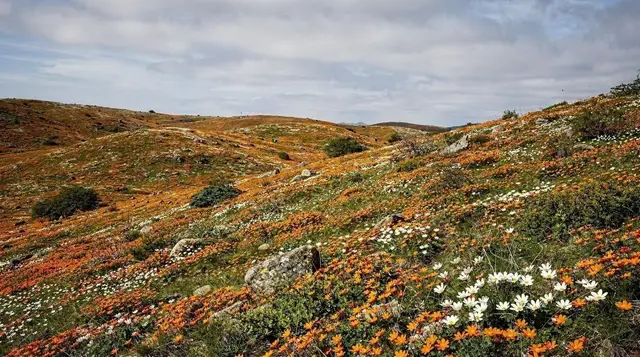
West Coast wildflower season
When exactly do the West Coast wildflowers bloom?
Roughly August into September in a typical year, though the display depends directly on winter and early spring rainfall, so the exact timing and quality shift year to year and some years are genuinely disappointing. There's no fixed calendar date that guarantees a good bloom — check recent rainfall and current reports close to your travel dates rather than booking purely off a generic seasonal window.
The West Coast’s spring wildflower bloom gets photographed constantly — carpets of orange, yellow and white stretching across open ground north of Cape Town — and in a good year, those photos are entirely accurate. What they don’t show is the gamble underneath: this bloom depends directly on rainfall, and not every year delivers it. Here’s the honest version of when and how to plan around it.
| Where | West Coast National Park and surrounding areas north of Cape Town |
| Season | Roughly August into September, rainfall-dependent |
| Getting there | Self-drive is the most common approach, roughly 1-1.5 hours from Cape Town |
| Reliability | Genuinely variable year to year — good winters produce spectacular displays; dry winters can disappoint |
| Best strategy | Check recent rainfall and current bloom reports close to your travel dates rather than booking purely by calendar |
Why this bloom is different from a garden’s flowering season
Unlike Kirstenbosch or the fynbos that covers much of the Cape year-round, the West Coast’s spring spectacle is dominated by annual and bulb flowers that germinate, flower and set seed within a single season, directly triggered by winter and early spring rainfall. In a wet winter, these species erupt into the carpet-like floral displays the region is known for. In a dry winter, the same ground can produce a far more modest, patchy showing — the plants are still there in seed form, simply waiting for a better year rather than failing to exist at all.
This is the single most important thing to understand before planning a trip specifically around this bloom: it’s a real, spectacular phenomenon in the right conditions, and a genuinely underwhelming one in the wrong conditions, and there’s no way to guarantee which you’ll get months in advance.
Roughly when to expect it
In a typical year, the bloom tends to build through August and into September, though the exact timing shifts with that season’s specific rainfall pattern — an early wet spell can bring flowers on sooner, while a late or light winter can push or dampen the display. This West Coast National Park flower tour runs during the general bloom window, though as with any wildflower-focused trip, it’s worth checking current conditions with the operator close to your dates rather than assuming a fixed date guarantees peak bloom.
Where to look
West Coast National Park is the most consistently referenced destination for this display, with its varied terrain — open plains, coastal fynbos, and areas of seasonal wetland — supporting a broad range of flowering species depending on where and when rain has fallen most recently within the park itself. Bloom patterns can vary meaningfully even within the park across a single season, since rainfall isn’t perfectly uniform across the area.
Combining wildflowers with a wider hike
This wildflower trails hiking tour builds actual walking into the visit rather than a drive-through viewing, which tends to produce a better experience of the bloom than staying in a vehicle — many of the smaller, more delicate flowering species are easy to miss at driving speed and reward a slower, on-foot pace.
If the bloom itself turns out to be underwhelming on a given visit, the wider West Coast landscape still offers worthwhile outdoor activity independent of the flowers. This fatbike dune tour in Walker Bay Nature Reserve is a reasonable alternative or add-on for travellers who want to build in a backup plan rather than pinning the whole day on a bloom that may or may not deliver.
Building in flexibility
Given the genuine unpredictability of the bloom, it’s worth treating a West Coast wildflower visit as one component of a broader Cape day rather than the sole reason for the trip, particularly if your travel dates were fixed well in advance and you can’t shift them around current rainfall conditions. Pairing the visit with other Winelands or nature-reserve hiking — such as this Jonkershoek Nature Reserve Panorama Trail hike or this Leopard’s Loop hike in Helderberg Nature Reserve — means a disappointing bloom year doesn’t sink the whole day.
Checking conditions before you commit
The most useful thing any traveller can do ahead of a wildflower-focused trip is check recent rainfall reports and current bloom updates as close to the travel date as practical, rather than relying on a generic “August-September” window from a guidebook or blog post written in a different year. Local tour operators running current-season trips are generally a more reliable, up-to-date source on that specific week’s conditions than any fixed seasonal guide can be.
Frequently asked questions about West Coast wildflower season
Is the West Coast wildflower bloom guaranteed every year?
No — it depends on winter and early spring rainfall, and dry years produce a noticeably weaker, sometimes disappointing display. Don’t build an entire trip’s timing around a guaranteed spectacle; treat it as a real possibility rather than a certainty.
Where’s the best place to see West Coast wildflowers near Cape Town?
West Coast National Park is the best-known and most consistently referenced location, with other spots further up the West Coast also known for strong displays in good years.
How is the wildflower bloom different from Kirstenbosch or fynbos generally?
The West Coast bloom is largely made up of seasonal annual and bulb flowers responding directly to winter rain, producing a short, dramatic, weather-dependent display. Fynbos and Kirstenbosch’s plantings are a more permanent shrubland ecosystem with flowering spread more broadly across the year rather than concentrated in one rain-dependent window.
Do I need a guide or tour to see the wildflowers well?
Not strictly — self-drive access to West Coast National Park is straightforward — but a guided tour can help with timing (checking which areas are currently blooming) and access to less obvious viewing spots, which matters more here than at a fixed-location garden like Kirstenbosch.
tours.gardens-nature
Verified deep-linked GetYourGuide tours. Book through these links and we earn a small commission at no cost to you.
Photos show the destination, not the operator's own images.