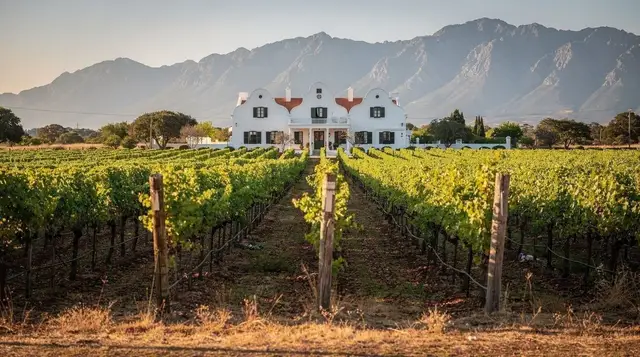
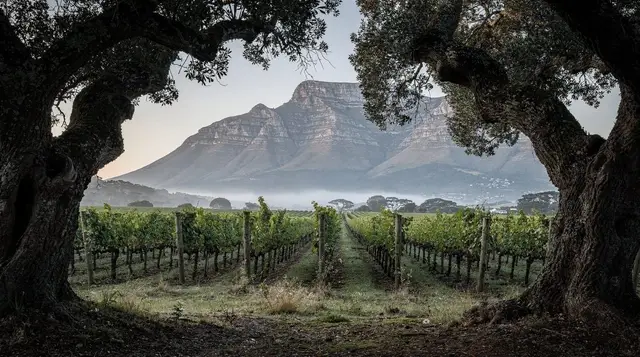
Paarl doesn’t get the same billing as Stellenbosch or Franschhoek, and that’s arguably the point for some visitors: it’s home to some of the Winelands’ oldest and largest wine estates, spread across a bigger, quieter town, without the tasting-room queues that build up on Stellenbosch’s more compact circuit during peak season. Neighbouring Wellington, smaller again, adds a scattering of boutique producers worth knowing about if the bigger Paarl estates start to feel corporate.
| Where | Winelands, roughly 45-60 minutes from Cape Town CBD |
| Time needed | Full day for Paarl and Wellington together; a half-day if paired with another Winelands town |
| Getting there | Self-drive via the N1 is straightforward and quick; guided tours typically include Paarl on a wider Winelands route |
| Cost | Tasting fees vary by estate, often waived with a bottle purchase — check current rates directly |
| Best time | Year-round; harvest season (February-April) for cellar activity, spring for the mountain reserve’s wildflowers and milder hiking |
Why Paarl stays quieter
Paarl is a larger town than either Stellenbosch or Franschhoek, and its wine estates are spread across a wider area rather than clustered into an easily walkable circuit. That geography works against the kind of dense, bus-tour-friendly tasting crawl that Stellenbosch and Franschhoek attract, which in practice means shorter waits at the tasting counter and more attention from the pourer — a genuine advantage if a rushed, crowded tasting room is what you’re trying to avoid, even if it means slightly more driving between stops.
Some of the valley’s biggest, most historically significant producers are based here, several tracing their cellars back over a century, with the scale of infrastructure — larger tasting rooms, restaurants, sometimes small museums on-site — to match. KWV, the cooperative that for much of the twentieth century controlled South Africa’s entire wine and brandy industry under government-backed regulation, is based in Paarl, and its historic cellar complex is worth a stop for the sheer scale of the operation alone, quite apart from the wine itself — a reminder that Paarl’s role in South African wine history runs deeper than a single estate’s marketing suggests.
A half-day Stellenbosch and Paarl combined tour is a practical way to sample both towns’ different characters without committing a full day to either.
Paarl Mountain and the Afrikaans Language Monument
Paarl Mountain Nature Reserve, on the town’s edge, is a granite outcrop of exposed domed rock — the source of the town’s name, from the Dutch for “pearl,” reportedly after Dutch explorers saw the wet granite gleaming in the sun. The reserve has walking and cycling trails through fynbos, plus genuinely good views back over the valley, and it’s a legitimate half-day on its own for anyone wanting a break from tasting rooms.
Within the reserve stands the Afrikaans Language Monument (Afrikaanse Taalmonument), commemorating the development of Afrikaans as a written language — a series of concrete forms representing the language’s various influences, including Dutch, Malay, and southern African indigenous languages, among others. It’s a striking piece of architecture regardless of interest in the linguistic history, and worth the short detour for the view alone.
Wellington: the smaller neighbour
Wellington, a short drive north of Paarl, is smaller again and less visited than either Paarl or the main Winelands towns, with a scattering of boutique and family-run wine and brandy producers rather than the large historic estates Paarl is known for. It doesn’t have the tourist infrastructure of Stellenbosch or Franschhoek — fewer restaurants, less signposted for casual visitors — which suits travellers specifically looking for a low-key, non-touristy wine stop rather than a full day’s itinerary.
Wellington is also historically associated with South Africa’s brandy production; a handful of producers in the area distil alongside their wine operations, worth asking about specifically if brandy interests you more than wine on its own.
Combining Paarl into a wider Winelands route
Because Paarl sits roughly between Cape Town and Franschhoek/Stellenbosch geographically, it works well as a stop on a wider loop rather than a single dedicated destination for most visitors, unless the Language Monument or a specific estate is the priority.
A combined Paarl, Stellenbosch and Franschhoek day tour covers all three towns for travellers with only one day, though — as with any single-day, three-town itinerary — expect a lighter touch at each stop rather than a deep dive into any of them.
For a more focused half-day that doesn’t try to cover the whole valley, a half-day Winelands tour with a local guide allows more time at fewer stops, generally the better trade-off if unhurried tastings matter more than ticking off every town.
A full day, done properly
For travellers who want the whole valley without the bus-tour pace, a full-day Winelands tour spreads the visits across more hours, giving Paarl’s larger estates and Wellington’s smaller producers room to breathe alongside whichever other towns the route includes.
What isn’t worth the detour
Paarl’s main street itself, away from the wine estates and the mountain reserve, is a functional working town rather than a curated tourist strip — there’s little reason to linger in the commercial centre specifically unless running an errand. The estates, the mountain reserve, and Wellington’s boutique producers are where the actual visit happens; budget time accordingly rather than expecting a Stellenbosch-style historic core downtown.
Getting there and around
Self-driving from Cape Town takes roughly 45 minutes to an hour via the N1, one of the more straightforward Winelands drives with less mountain-pass driving than the route to Franschhoek. A car is genuinely useful here given how spread out the estates are — more so than in Stellenbosch’s tighter circuit — so self-driving with a designated non-taster, or a guided tour, both make more sense than trying to walk between stops.
How this fits into a longer trip
Paarl and Wellington work well slotted between Stellenbosch and Franschhoek on a wider Winelands loop, or as a quieter counterpoint if the bigger towns’ crowds have already worn thin on a multi-day Winelands stay. Travellers heading north afterward sometimes continue toward the Cederberg, though that’s a longer drive than a same-day add-on comfortably allows.