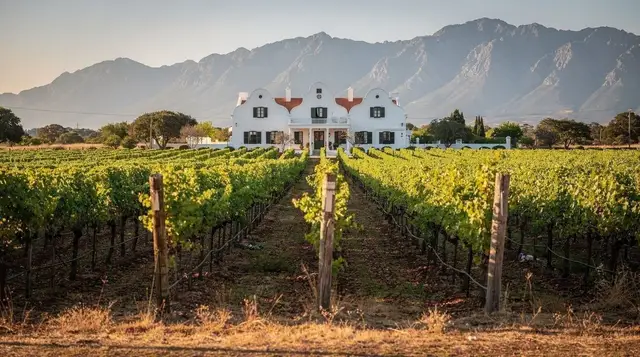
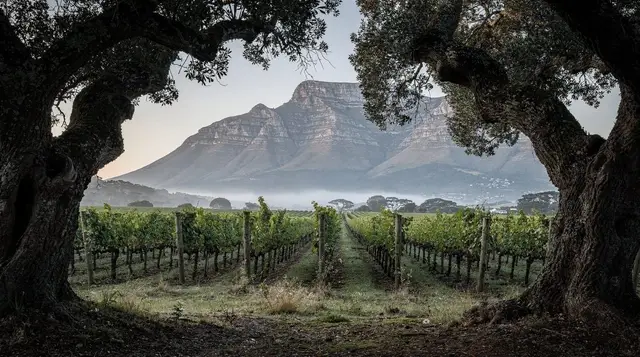
Franschhoek is the smallest and most concentrated of the main Winelands towns, and that concentration is exactly its appeal: a short main street lined with some of the Western Cape’s most highly regarded restaurants, wine estates within genuine walking or short-tram distance of each other, and a valley setting — steep mountains closing in on three sides — that’s more dramatic than Stellenbosch’s broader, flatter spread.
| Where | Winelands, about 1 hour to 1 hour 15 minutes from Cape Town CBD |
| Time needed | Full day; a focused half-day if you’re only doing the Wine Tram |
| Getting there | Self-drive via the R45 (spectacular over the Franschhoek Pass), or a guided tour that handles the driving |
| Cost | Wine Tram tickets and tasting fees vary — check current pricing directly; many restaurants require booking well ahead, especially in peak season |
| Best time | Year-round; February-April is harvest season and the busiest window, spring and autumn are quieter |
A town founded by refugees
Franschhoek — the name translates as “French Corner” — was settled in the late 1680s by French Huguenot refugees, Protestants who’d fled religious persecution in France following the revocation of the Edict of Nantes. The Dutch East India Company granted them farms in this valley, and while the community assimilated into the broader Cape Dutch culture within a couple of generations (Dutch became the dominant language surprisingly fast), the valley’s wine-growing tradition and a scattering of French-derived farm names are a direct legacy of that settlement.
The Huguenot Memorial and Museum, at the top of the main street, tells that history in more depth for anyone wanting the fuller picture beyond the postcard version — a monument of three linked arches representing Faith, Hope and Charity, alongside a small museum tracing the individual families who settled the valley.
The Wine Tram: how it actually works
The Franschhoek Wine Tram is the town’s signature way to taste without driving. It runs several colour-coded lines, each following a fixed route to a specific set of participating estates, using a combination of an open-sided vintage-look tram carriage for parts of the route and a shuttle bus for the rest. You buy a ticket for a line, hop off at whichever stops interest you, taste, then catch a later tram or shuttle onward or back.
The trade-off worth understanding before booking: each line only serves its own estates, so picking the wrong line for the estates you actually want to visit means missing them entirely. Read the current route map for each colour line before choosing, rather than assuming they’re interchangeable.
The hop-on hop-off Wine Tram ticket is the standard way to do this independently, at your own pace, without a group tour’s fixed schedule.
For travellers who’d rather have tastings arranged rather than choosing estates themselves, a Wine Tram package with tastings included bundles the ride with a set number of cellar visits.
Franschhoek’s other identity: the food
Franschhoek has, disproportionately for its size, one of the highest concentrations of serious restaurants in South Africa — a legacy partly of the Huguenot food culture and partly of decades of chefs deliberately choosing the valley as a base. Reservations at the most sought-after tables fill up well in advance, especially over weekends and through the summer season, so this is not a town to arrive in hungry and hope for a walk-in table at the best-known spots. Casual options along the main street are far more forgiving of last-minute planning.
A different angle: black-owned wine estates
Franschhoek’s wine industry, like the Winelands generally, has historically been dominated by white-owned estates, a legacy of land ownership patterns going back to apartheid and further. A small but growing number of black-owned wine farms in and around the valley offer both a different tasting experience and a more direct route into that history and its present-day context, rather than treating it as a footnote.
A guided tour to a black-owned Franschhoek wine farm covers that history alongside the tasting, for travellers who want the valley’s context, not just its cellars.
Franschhoek Pass: the drive itself
However you arrive, the R45 over Franschhoek Pass deserves attention on its own merits — switchbacks climbing through mountains with views back over the valley floor, genuinely one of the more scenic short drives in the Winelands. If self-driving, this is not a road to take distracted or in a hurry; if being driven, it’s worth looking up rather than at a phone for this stretch specifically.
Combining Franschhoek with Stellenbosch
Most multi-day Winelands visitors pair Franschhoek with Stellenbosch, either as two separate day trips or as one longer combined day. Combining both in a single day is doable but tight — expect fewer tastings at each town than a dedicated day would allow, and be realistic that Franschhoek’s food scene alone can easily fill an afternoon without a single estate visit.
A combined Stellenbosch and Franschhoek day with Wine Tram access covers both towns for travellers with only one day to spare, at the cost of depth at either.
Full-day option for a longer visit
For a slower pace that doesn’t compress Franschhoek into a half-day add-on, a full-day Wine Tram hop-on hop-off pass gives the most flexibility to move between stops, linger over lunch, and not watch the clock against a return shuttle time — worth the upgrade over a standard ticket if the plan is to properly work through several estates rather than sample two or three quickly.
What isn’t worth the detour
Some of the estates directly on the Wine Tram’s busiest lines see enough tram traffic that tasting-room service can feel rushed during peak hours, particularly midday on weekends in high season. If a slower, more personal tasting matters more than convenience, it’s worth asking locally (or a guide, if using one) which stops on a given line tend to be quieter, or considering a self-drive visit to a smaller estate off the main tram routes instead.
Getting there and around
Self-driving from Cape Town takes roughly an hour to an hour and fifteen minutes via the N1 to Stellenbosch, then the R45 or the more direct R310/R45 route, traffic and route choice depending. There’s no rail option to Franschhoek, unlike Stellenbosch, so it’s self-drive or a booked tour. Within the town itself, the main street and the Wine Tram stops are all walkable; a car (or the tram) is only needed to reach estates further out.
How this fits into a longer trip
Franschhoek combines naturally with Stellenbosch for a two-town Winelands day, or with Paarl and Wellington for a wider loop through the valley that avoids backtracking. Travellers continuing south toward whale season often add a Hermanus stop the following day.