Apartheid history in Cape Town
What are the essential apartheid history sites to see in Cape Town?
Robben Island, where Nelson Mandela spent eighteen of his twenty-seven years in prison; the District Six Museum, which documents the forced removal of tens of thousands of residents after the area was declared whites-only in 1966; and Bo-Kaap, a Cape Malay quarter whose history stretches back to Cape slavery. Together they cover imprisonment, forced removal and the deeper roots of segregation, and are best visited with some background on the Group Areas Act and the liberation struggle rather than cold.
Apartheid was a legal system of racial segregation enforced by the South African state from 1948 into the early 1990s, and Cape Town carries some of its clearest physical evidence — a former political prison reached by ferry, a city district demolished and left largely empty for decades, and a historic quarter whose community’s roots run back through slavery and colonial exile. This isn’t background scenery for a beach-and-mountain trip; for many visitors, engaging with this history seriously is a central reason to come. Here’s where it’s visible, and how the sites connect to one another.
| Core sites | Robben Island, District Six Museum, Bo-Kaap, Castle of Good Hope, the Slave Lodge |
| Time needed | A tight full day for the essentials; two days for an unhurried visit |
| Getting around | Robben Island by ferry only; the rest walkable within or near the City Bowl |
| Best approach | Some background reading beforehand — the sites reward context, not a cold visit |
| Tone | Weighty by design; not built or intended as entertainment |
Where apartheid’s roots actually go
Apartheid as a formal legal system dates to 1948, but the racial hierarchy it codified didn’t appear from nothing that year — it built on centuries of earlier colonial-era slavery and discrimination at the Cape, dating back to Dutch East India Company rule in the seventeenth century. The Slave Lodge on Adderley Street, built by the Dutch East India Company to hold enslaved people, and the Castle of Good Hope, the country’s oldest surviving colonial building, both predate apartheid by well over two hundred years and are part of the same longer story of Cape Town’s built environment reflecting who held power and who didn’t. See the Slave Lodge and Cape slavery guide and the Castle of Good Hope guide for more on that earlier period.
Apartheid history and city walking tour is a useful way to get this longer arc explained in sequence by a guide, rather than piecing the chronology together site by site on your own.
Robben Island: imprisonment as state policy
Robben Island, reached only by ferry from the Nelson Mandela Gateway at the V&A Waterfront, held the apartheid state’s political prisoners — organisers and leaders of the liberation movement the government considered most dangerous. Nelson Mandela spent eighteen of his twenty-seven years in prison there, and the tour, guided by former political prisoners, covers both the limestone quarry where forced labour took place and the cell blocks themselves. Crossings are cancelled in rough seas, so this is the one site on this list where booking well in advance genuinely matters — see the Robben Island guide for the full detail.
Half-day anti-apartheid struggle tour from Cape Town covers the wider liberation history for visitors who want context beyond Robben Island alone.
District Six: what forced removal looked like in practice
In 1966, District Six — a dense, mixed inner-city neighbourhood — was declared a whites-only area under the Group Areas Act. Tens of thousands of residents were forcibly removed over the years that followed, their homes bulldozed, and the land was largely never redeveloped. The District Six Museum, run substantially by former residents, documents this through recovered street signs and a floor map annotated by hand with the memories of the people who lived there. It’s one of the most direct single illustrations of what the Group Areas Act meant for an actual community, not an abstract policy. See the District Six Museum guide.
Bo-Kaap: a community that survived
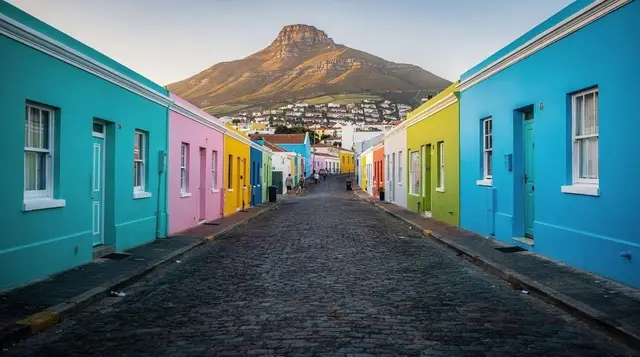
Not every historic community in Cape Town was destroyed the way District Six was. Bo-Kaap, home to a Cape Malay community descended from enslaved people and political exiles deported from Dutch colonies in Southeast Asia, remains a lived-in neighbourhood today, though it now faces a different pressure — gentrification and rising property prices pushing out some of the same families whose history gives the area its identity. See the Bo-Kaap guide for that fuller picture.
Robben Island, District Six and Mandela history tour links the two central sites of imprisonment and forced removal into a single, coherent day.
Townships: where the policy pushed people
Apartheid’s system of racial classification didn’t only remove people from areas like District Six — it also determined where they were forced to live instead, and Cape Town’s townships, including Langa and Khayelitsha, are the direct result. Visiting a township with a responsible, community-based operator adds a dimension the historical sites alone don’t fully capture: not just what was destroyed, but where people were pushed, and how those communities built lives and culture in the areas apartheid confined them to. See the township tours ethics guide before booking, since the ethics of this kind of visit deserve real thought, and the Langa guide for the deepest single-township history on this list.
The liberation struggle beyond individual sites
Cape Town also carries broader commemoration of the anti-apartheid struggle beyond any single building — public art, museum exhibitions and guided tours dedicated specifically to the movement that eventually ended the system, including figures far less internationally known than Mandela but central to how the struggle actually unfolded on the ground.
The Long March to Freedom is a large sculptural installation commemorating figures across the liberation movement, worth visiting alongside the historical sites for a sense of how many people, not one, drove that history forward. Robben Island with the Long March to Freedom exhibit and Iziko Museum combines that installation with Robben Island and the wider Iziko museum network in a single booking.
Visiting this history responsibly
None of these sites are entertainment, and none should be photographed or narrated as though they were. Guides at Robben Island and District Six in particular often carry direct personal or family connections to what they’re describing — take the pace they set, ask questions if you have them, and don’t treat a heavy site as a quick stop between lighter ones on a packed itinerary.
tours.history-heritage
Verified deep-linked GetYourGuide tours. Book through these links and we earn a small commission at no cost to you.
Photos show the destination, not the operator's own images.