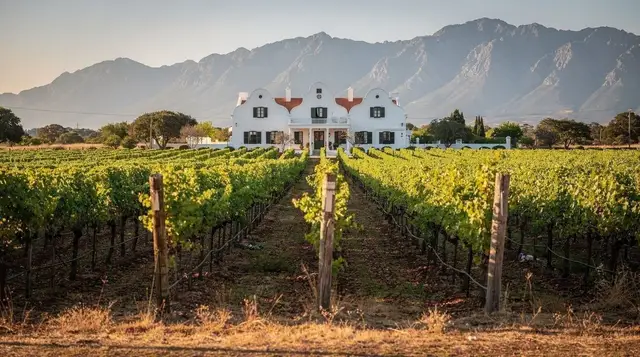
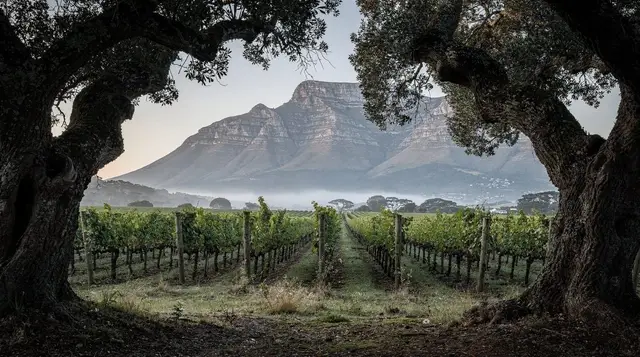
Stellenbosch wine route guide
How far is Stellenbosch from Cape Town, and can I do it as a day trip?
Stellenbosch is roughly 45-50 minutes from central Cape Town by road, which makes it a straightforward day trip either self-driven, on a guided tour, or by train. Most visitors treat it as a full-day outing rather than a quick stop, since the town itself and the surrounding estates both reward unhurried time.
Stellenbosch is the largest and, for many visitors, the default Cape Winelands destination — it has the greatest concentration of estates, the most varied styles of wine, and a genuinely attractive university town at its centre that holds its own even without the vineyards. The trade-off is choice: with so many producers spread across several distinct wine routes, a first-time visitor can easily spend the whole day deciding rather than tasting. Here’s how to plan one properly.
| Where | Stellenbosch, roughly 45-50 minutes east of central Cape Town |
| Time needed | A full day for the estates and the town; a half-day covers two or three tastings |
| Getting there | Self-drive, guided tour, train, or a private driver |
| Cost | Tasting fees per estate, generally deducted against a purchase |
| Best time | Year-round; harvest season, roughly February-March, adds cellar activity |
The town before the wine
Stellenbosch was founded in 1679 by the Dutch Cape Colony’s governor, making it South Africa’s second-oldest town after Cape Town itself, and its historic core still shows it: oak-lined streets planted centuries ago, well-preserved Cape Dutch gables, and museum houses tucked among working cafés and restaurants. Stellenbosch University adds a genuinely different energy from the other Winelands towns — more students, more casual dining, a livelier evening scene if you’re staying over. It’s worth budgeting at least an hour or two to walk the centre before or after tasting, rather than treating the town purely as a base.
Choosing your estates
Stellenbosch’s wine farms are loosely organised into several routes radiating out from the town, each with a slightly different character — some cluster historic Cape Dutch manor houses with formal tasting rooms, others are smaller, family-run cellars with a more informal pour. Trying to cover more than one route in a day means significant driving between stops, so it’s worth picking a cluster and staying reasonably close to it rather than criss-crossing the whole area.
This half-day Stellenbosch wine tour is a practical starting point for a first visit — it groups two or three estates within a manageable radius and takes the route-planning decision off your hands.
Pinotage country
Stellenbosch has a particular claim to South African wine history: pinotage, the country’s signature red grape, was first bred here in 1925 as a cross between pinot noir and cinsaut, and several Stellenbosch estates still treat it as their flagship variety. It’s a grape that divides opinion — smoky, earthy, sometimes an acquired taste next to more familiar reds — but tasting a well-made example on its home turf is one of the more distinctive things you can do on a Winelands day.
This Stellenbosch pinotage-focused wine tour is built specifically around that grape, useful if you want to understand what the fuss is about rather than just sampling it in passing. See the South African wine varieties guide for how pinotage compares to the country’s other signature grapes.
Covering more ground
If your priority is breadth over depth — seeing a wider spread of Stellenbosch’s estates in a single outing rather than lingering at two or three — a multi-estate route is the better fit than a self-planned day.
This five-estate Stellenbosch wine tour covers considerably more ground than a typical half-day, though it does mean shorter time at each stop; weigh that trade-off against how much you actually want to linger at any single cellar.
Getting between estates without driving
The same rule applies here as anywhere in the Winelands: South Africa’s drink-driving law is strict, and Stellenbosch’s estates are spread across farm roads that aren’t realistic to walk between. A hop-on hop-off service, tuk-tuk, or guided tour solves this without requiring a designated driver to skip the tasting.
This hop-on hop-off tractor-drawn wine tour is a genuinely different way to move between estates — slower, more scenic, and it removes any question of who’s driving. For a fuller comparison of every no-drive option across the Winelands, see doing the Winelands without driving.
When to visit
Stellenbosch works year-round, but the character of a visit shifts with the season. Harvest, roughly February to March, brings visible cellar activity and, at some estates, the chance to see grapes being processed. Spring and fine autumn days offer the most comfortable walking weather for the town itself, while the height of summer (December-February) is busiest, especially at weekends, when tasting rooms and popular restaurants fill up faster.
This premium half-day Stellenbosch tour is worth considering if you’d rather prioritise fewer, higher-end estates over covering more ground — a different pace from a five-estate route, better suited to a slower, more indulgent afternoon.
Combining Stellenbosch with the rest of the day
Stellenbosch sits close enough to Paarl and Franschhoek that a combined itinerary is common, though it does mean less time at each valley. If you’d rather keep the day focused, staying within Stellenbosch’s own routes and giving the town centre proper time afterwards tends to make for a more satisfying, less rushed visit than trying to tick off three valleys in one go.
tours.wine-tasting
Verified deep-linked GetYourGuide tours. Book through these links and we earn a small commission at no cost to you.
Photos show the destination, not the operator's own images.