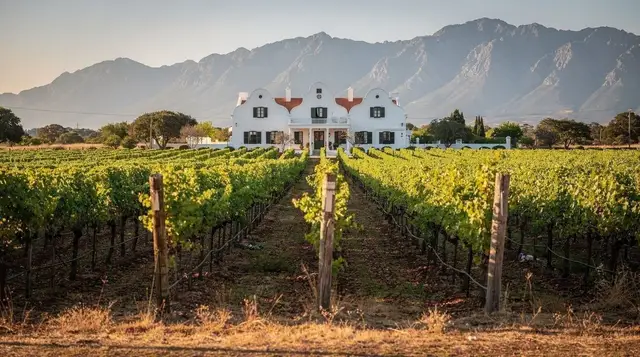
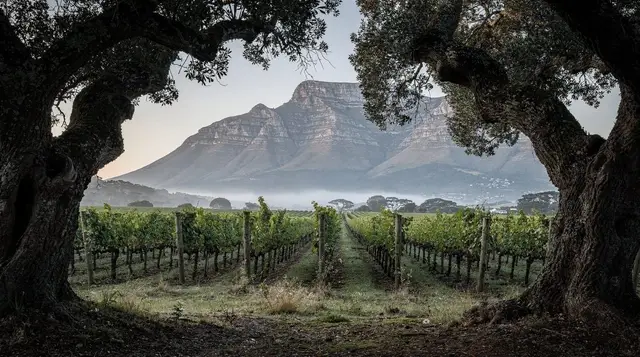
Constantia Valley is South Africa’s oldest wine-producing region, tucked into the Southern Suburbs at the base of the mountains only about 20 minutes from central Cape Town — closer than any other established wine area on this itinerary. Groot Constantia, the valley’s founding estate, was established in 1685, and its wines were served at European courts within a century, a history that gives the valley a different character from the newer, larger operations further out in Stellenbosch and Franschhoek. It’s a compact, easily walkable-between-a-few-estates region, which makes it the sensible choice when time is short and you’d still rather taste wine somewhere with real history than settle for a generic tasting room.
| Where | Southern Suburbs, about 20 minutes from the city centre |
| History | South Africa’s oldest wine region, founded 1685 |
| Getting there | Self-drive, rideshare, or a guided tour |
| Time needed | Half a day for two or three estates; a full day for more |
| Best for | Visitors short on time who still want a genuine wine estate experience |
Groot Constantia and the valley’s origins
Groot Constantia was established by Simon van der Stel, the Dutch East India Company governor the town of Stellenbosch is named after, and its sweet wine — historically known simply as Constantia wine — became one of the most sought-after exports from the Cape in the eighteenth and nineteenth centuries, reportedly favoured by figures including Napoleon during his exile. The estate’s Cape Dutch manor house and wine cellar are among the best-preserved examples of the architectural style anywhere in the region, and a visit here combines the tasting with a genuine sense of the Cape’s colonial-era wine history, for better or worse a history worth understanding rather than glossing over.
Private Constantia wine valley half-day tourThe other estates worth knowing
Beyond Groot Constantia, the valley holds a handful of smaller, well-regarded producers with their own distinct character: Klein Constantia, which revived the historic sweet Constantia-style wine under the Vin de Constance label; Steenberg, known for sauvignon blanc and a striking modern tasting room set against an eighteenth-century manor; and Buitenverwachting, whose name translates roughly as “beyond expectation” and which pairs a strong tasting programme with one of the valley’s better restaurants. A tour covering several estates in a single day makes the most sense if you want to compare styles rather than settling in at one.
The Constantia Classic full-day tourFor a slower, more intimate way through the valley, a guided walking tour between estates — with lunch built in — trades efficiency for the chance to actually experience the landscape between tastings rather than just driving between them.
Constantia wine walk with lunch and storiesPairing Constantia with Kirstenbosch
Constantia Valley sits immediately south of Kirstenbosch National Botanical Garden, and the two combine naturally into a single day — gardens and a mountain hike in the morning, wine in the afternoon, without a long drive between them. Several tours combine Constantia with Kirstenbosch and, further afield, Boulders Beach’s penguin colony, for visitors who want to cover several distinct experiences in one guided day rather than picking just one.
Boulders Beach, Kirstenbosch and Constantia tourHow Constantia compares to Stellenbosch and Franschhoek
Constantia is smaller and closer, which is both its advantage and its limit. If you have a single half-day for wine and don’t want to commit to an hour or more of driving each way, Constantia is the practical choice, and its history arguably outweighs both Stellenbosch and Franschhoek combined. If you have a full day and want a wider range of styles, more estates to choose from, and towns built specifically around the wine trade, Stellenbosch and Franschhoek offer more breadth. Neither choice is wrong; it’s a genuine trade-off between convenience and scale.
Beyond the tasting room
Several Constantia estates pair their wine programme with genuinely good food and scenery beyond the cellar door — Buitenverwachting’s picnic offering on the lawns in front of the manor house is a popular warm-weather option, and a handful of estates sit close enough to Table Mountain National Park’s Constantia section to combine a short walk with the tasting itself. The valley’s relatively small size means it rewards a slower, more deliberate day over trying to squeeze in as many estates as possible — two or three unhurried stops generally make for a better day than five rushed ones.
Practicalities
Most Constantia estates offer tastings on a walk-in or booked basis, with fees varying by estate and whether you’re tasting standard or premium ranges — check current rates directly with each estate rather than assuming a fixed price across the valley. Driving between estates is straightforward given the valley’s compact size, though a guided tour removes the need to nominate a designated driver, which matters more here than it might elsewhere given how easy it is to taste at several stops in a single afternoon.
Getting there
There’s no direct rail line into Constantia Valley, so self-driving, a rideshare, or a guided tour are the practical options. From central Cape Town it’s a straightforward 20-minute drive via the M3, making it one of the few wine regions anywhere reachable without dedicating the better part of a day to travel alone.
What to bring
Comfortable shoes suit a day moving between cellar doors and, in some cases, gardens or short vineyard walks. Booking ahead is worth doing in peak season and around harvest, when tasting rooms can fill up, particularly for anything beyond a standard walk-in tasting. If you’re driving yourself between estates, pace tastings across the day and keep a designated driver or rideshare plan in place — a guided tour sidesteps the issue entirely, which is part of its appeal here.