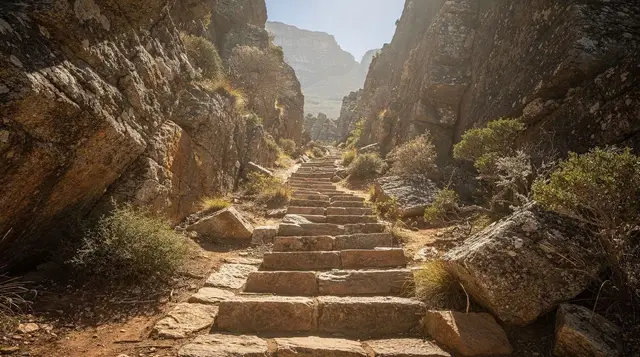
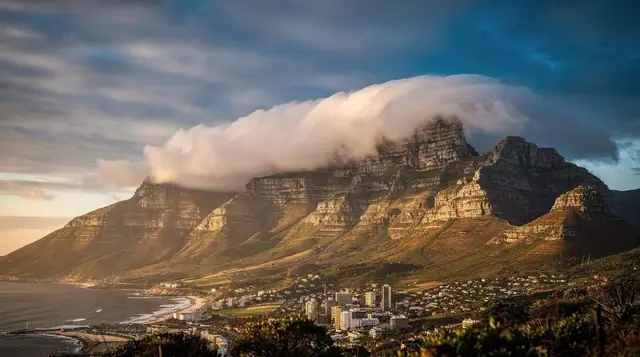
Abseiling off Table Mountain
Do I need climbing experience to abseil off Table Mountain?
No. Commercial abseiling off Table Mountain is guided from start to finish — an instructor fits your harness, checks your rope system, and talks you down the rock face. You need reasonable comfort with heights and the ability to walk to the site from the upper cableway station, but no prior rope or climbing experience.
Table Mountain’s flat summit plateau makes it an unusually convenient place for a guided abseil: the cableway does the hard work of getting you up, and a short walk across the top brings you to a rock face where an instructor clips you into a rope system and talks you over the edge. It’s a genuinely different way to experience the mountain from the cable car queue or the summit paths, and it doesn’t require the technical background the word “abseiling” might suggest. Here’s what the day actually involves.
| Where | Upper Table Mountain plateau, reached via the Aerial Cableway |
| Time needed | Half a day, once cableway access and the return trip are included |
| Who it’s for | Visitors comfortable with heights and a short walk on uneven ground; no rope experience needed |
| Cost | Varies by operator and whether the cableway ticket is bundled in; check current pricing when booking |
| Best time | Mornings, when wind is typically calmer and the cableway is more likely to be running |
How a guided abseil actually works
Every part of the technical side is handled by trained staff. An instructor fits your harness, attaches you to a rope anchored above the drop, and briefs you on how to walk backwards over the edge and control your own descent speed with the rope in your hand — the same basic mechanics used in guided abseils anywhere in the world, just with one of the more striking backdrops available for it. This guided Table Mountain abseil follows that format: cableway access, a walk to the site, a safety briefing, and the descent itself under an instructor’s direction the whole way down.
Nerves are normal, and instructors are used to talking first-timers through the moment of leaning back over the edge, which is the part almost everyone finds hardest regardless of general fitness or confidence. Once you’re moving, most people describe the actual descent as more manageable than that first step suggested it would be.
Why it depends entirely on the cableway
Abseiling off Table Mountain isn’t a standalone booking in the way a city walking tour is — it sits on top of the Aerial Cableway, which is itself closed by strong wind or low cloud on a fairly regular basis. If the cableway isn’t running, there’s no way to reach the abseil site, so a wind-affected day can mean a same-day cancellation or reschedule regardless of how the abseil operator itself is performing. A Table Mountain cableway ticket is worth understanding on its own terms before you book an abseil around it, since the two are inseparable in practice.
This is the same pattern that affects paragliding, scenic flights, and boat trips around the city: Cape Town’s geography, sitting between two coastlines and a mountain range, produces genuinely changeable wind, and the fair-weather activities built around the mountain and coast all share that dependency. Treat an abseil slot as flexible rather than fixed, and don’t schedule it for your only free window.
What the descent itself feels like
The rock face used for commercial abseiling drops from the plateau edge with a clear view out over the city bowl and the Atlantic beyond, which is a large part of the appeal — you’re not descending into a shaft or a gorge, but out into open air with the whole of central Cape Town laid out below. The exposure is real and part of the point, but the rope system, harness, and instructor supervision are the same safety apparatus used for guided abseils generally, not an improvised or casual setup.
This abseil-and-hike combination pairs the descent with a guided walk back down one of the mountain’s trails rather than a return cableway ride, which turns the outing into a longer, more complete day on the mountain for anyone who wants more than a single activity slot.
Combining it with the rest of a Table Mountain visit
Most visitors treat the abseil as one part of a longer Table Mountain day rather than a dedicated standalone trip, since the cableway ride up and down and time on the summit plateau are worth building into the same visit regardless. This abseil and Sky Hi Ride combination bundles the descent with another mountain-top activity, which is a reasonable way to make the most of a single cableway trip if the weather cooperates for the whole day.
If you’re travelling with people who’d rather not abseil, the summit plateau itself has walking paths and viewpoints that don’t require it, so a mixed group can still spend the day together with only some of you doing the rope descent.
Cableway queues and timing your day
The cableway itself can involve a genuine wait, particularly in the December to February peak season when both locals and visitors are heading up in large numbers. If your abseil booking includes a specific cableway ticket or time slot, that generally lets you bypass the worst of the general queue, but it’s still worth building in more time than feels necessary — arriving with plenty of margin before your abseil slot is far better than rushing off a delayed cableway ride straight into a safety briefing. Checking in for the abseil itself is usually handled separately from the general cableway ticket office, with its own small team managing bookings, harnesses, and group sizes, so look out for signage or ask cableway staff directly if it isn’t obvious where to go once you’re at the top.
Reading the weather before you commit
The single most useful habit for this activity is learning how the mountain behaves. The famous cloud that spills over the plateau edge and the strong southeasterly that locals call the Cape Doctor are the two things that decide whether the cableway runs, and therefore whether your abseil happens. Our guide to the Table Mountain tablecloth and its weather explains why a perfectly clear morning in the city can still mean a closed summit, and the piece on the Cape Doctor wind covers the seasonal pattern behind it.
In practice, that means checking the cableway’s operating status on the morning itself, looking up at the mountain from wherever you’re staying, and keeping your plans loose until you’ve seen both. If the summit is closed on your day, the blog post on what to do when Table Mountain is closed and our list of rainy-day activities in Cape Town give you somewhere sensible to redirect the day without writing it off.
Season shapes the experience too. Long, bright days in Cape Town in summer bring the busiest cableway queues and the windiest spells, while Cape Town in winter trades some of that wind for cold, rain and cloud. Neither season is simply better; they fail in different ways, so choose the one whose risks you’d rather manage.
How the abseil fits with the cableway and hiking choices
Because the abseil starts at the top, your real decision is how you get up and how you come down. The Table Mountain cableway guide walks through the ride itself, and the comparison of the cableway versus hiking helps if you’re torn between riding and walking. Some people ride up for the abseil and walk down afterwards, which is exactly the pattern the abseil-and-hike option is built around.
If you do plan to walk, read the Table Mountain hiking routes overview and the specific write-up of the Platteklip Gorge hike first, because a descent on foot after an adrenaline-heavy morning is still a real walk on uneven ground. The Table Mountain safety guide is also worth reading before any day that puts you on the mountain’s trails, as conditions up there can change faster than they do in the city. For the wider picture of the mountain as a destination, see the Table Mountain destination page.
Planning the rest of your day around it
A morning on the rope leaves the afternoon free, and Cape Town has plenty of other outdoor options nearby. Another good viewpoint is the hike up Lion’s Head, though doing both in one day is a lot for most people, so treat them as separate outings. If heights are the draw, paragliding from Signal Hill and scenic flights and balloon rides offer a very different way of looking down on the city, while kloofing and canyoning in the Western Cape is the natural next step for anyone who enjoys the rope-and-rock side of things.
If you’re mapping out a longer stay, the outdoors-focused six-day itinerary shows how mountain activities can be spaced between easier days, and the general advice in Cape Town trip planning helps you decide where a weather-dependent activity belongs in the sequence. Travelling as a family is a different question altogether, so check Cape Town with kids before assuming younger travellers can join in.
A calm way to approach the day
Treat the abseil as one good part of a day rather than a test of nerve. Arrive rested, listen carefully to the briefing, ask the instructor anything that’s unclear, and don’t be shy about telling the team if you’re nervous. They would much rather know. Wear sensible closed shoes suited to uneven ground, bring something warm for the plateau because it can feel cooler up there than in the city, and carry only what you’re comfortable keeping with you while you’re on the rope.
Once you’re back on solid ground, give yourself time on the plateau to take in the views you’ve just seen from a very different angle. Most people find the summit paths feel quite different afterwards, and that quiet stretch before heading back down is often what they remember best.
Making it part of a wider Cape Town stay
The abseil tends to work best when it sits inside a trip that already has some slack. If you only have a short stay, the one-day Cape Town itinerary and the three-day plan show how crowded a schedule becomes once the mountain, the waterfront and the coast are all competing for the same hours. A weather-dependent activity is much easier to place in a longer plan such as the five-day itinerary, where a closed cableway simply shifts the abseil to another morning.
It also helps to think about where you’re staying. Our notes on where to stay in Cape Town and on getting around the city will help you reach the lower cableway station without stress, and the guide to Cape Town’s safety covers the practical street-level habits that apply on the way there. For the bigger orientation, the destination page for Signal Hill and Lion’s Head shows how the other peaks around the city bowl relate to the mountain you’ll be roped down.
On the other side of the day, the V&A Waterfront guide is an easy, low-effort place to wind down after a morning of adrenaline, with food and sea views close at hand.
Who this actually suits
Reasonable comfort with heights matters more than fitness here — the walk from the cableway station to the abseil site is short and not physically demanding, and the descent itself is instructor-controlled rather than something requiring upper-body strength or technical skill. Visitors who are genuinely afraid of heights, or who have a medical condition that exertion or altitude could affect, should think carefully before booking, and it’s worth checking an operator’s specific age and health guidelines directly rather than assuming.
tours.table-mountain
Verified deep-linked GetYourGuide tours. Book through these links and we earn a small commission at no cost to you.
Photos show the destination, not the operator's own images.