Bo-Kaap, the Cape Malay quarter
Why are the houses in Bo-Kaap so colourful, and is it okay to photograph them?
Bo-Kaap is a historic Cape Malay quarter, home to descendants of people enslaved at the Cape and political prisoners deported from Dutch colonies in Southeast Asia. The bright house colours are a real, decades-old local tradition, not a tourist installation — and these are occupied homes with residents living ordinary lives behind the paint. Photographing the streets is fine; photographing a specific house closely, or with people visible, is worth asking about first.
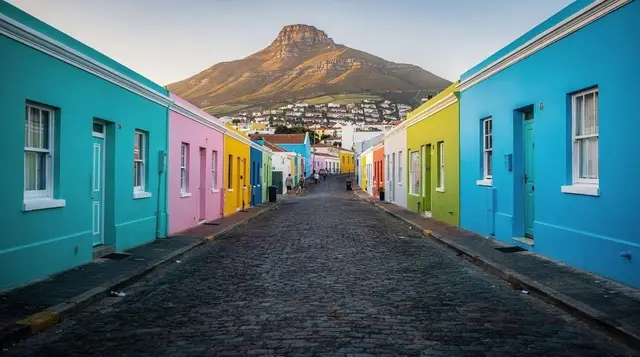
Bo-Kaap sits on the slopes above the City Bowl, its steep cobbled streets lined with houses in deep pink, turquoise, mustard and violet — an image that ends up on more Cape Town postcards than almost anywhere else in the city. What that image leaves out is that Bo-Kaap is a real neighbourhood, home to a Cape Malay community with roots going back to slavery and colonial exile, and that the colour is a genuine local tradition rather than something staged for visitors. Here’s the history behind the streets, and how to visit without treating people’s homes as a photo set.
| Where | Slopes above the City Bowl, a short walk from Long Street |
| What it is | A historic Cape Malay residential quarter, still lived in today |
| Getting there | Walkable from the City Bowl; steep, cobbled streets |
| Best for | Walking, Cape Malay cuisine, and understanding a real, occupied part of the city’s history |
| Etiquette | Ask before photographing specific houses or residents up close |
Who the Cape Malay community actually are
“Cape Malay” describes a community whose ancestry traces to people enslaved at the Cape from the mid-1600s onward, and to political and religious leaders exiled to the Cape by the Dutch from what are now Indonesia, Malaysia and other parts of Southeast Asia. Despite the name, the community’s origins span a wide range of places under Dutch colonial control, not a single “Malay” homeland — the label reflects the language and religious practice that took root at the Cape rather than one point of origin. Bo-Kaap became one of the neighbourhoods where this community settled, built mosques, and developed a distinct Cape Malay culture, cuisine and Islamic identity that has persisted for generations.
Bo-Kaap and city tour is a straightforward way to walk the quarter with someone who can explain that history properly rather than piecing it together from a guidebook on the move.
Why the houses are painted the way they are
The bright colours are a real, long-standing local tradition rather than a modern tourist invention, though accounts differ on exactly how and when the practice became widespread. What matters more than the precise origin story is what the houses are today: occupied family homes, many held within the same families for generations, not a municipal art installation. Treating the street as a backdrop is understandable given how striking it looks, but it’s worth remembering that every doorway you’re photographing is someone’s front door.
Walking tour of Bo-Kaap and city highlights covers the quarter alongside other central Cape Town sights, useful if you’re combining Bo-Kaap with a broader first look at the City Bowl.
The mosques of Bo-Kaap
Islam has deep roots in Bo-Kaap, and the quarter holds some of the oldest mosques in South Africa, founded by early Cape Malay religious leaders as the community established itself in the area. These mosques remain active places of worship today, not historical relics, and they continue to anchor the community’s religious and social life in the same way they have for generations. Walking past them, it’s worth remembering that they’re functioning institutions serving a living congregation, not sights arranged for visitors to view from outside.
Etiquette that actually matters here
The most common friction between Bo-Kaap residents and visitors isn’t walking the streets — it’s close-up photography of a specific house, sometimes with residents visible in the frame, taken without asking. A quick, polite request before photographing a particular home or a person costs nothing and is generally well received; assuming that a colourful front door is automatically fair game is the habit worth dropping. Bo-Kaap is also home to some of Cape Town’s oldest mosques, and modest dress is appropriate if you’re walking near them, particularly around prayer times.
The architecture behind the colour
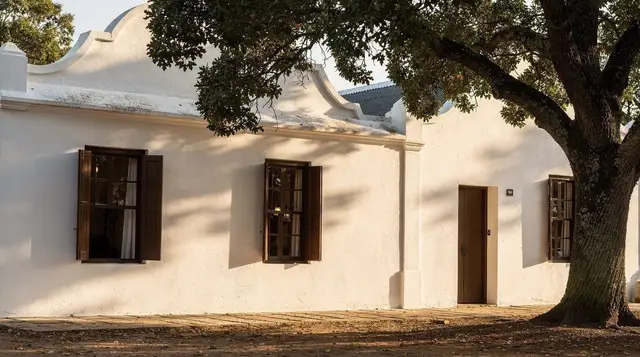
Beneath the paint, Bo-Kaap’s houses follow architectural styles brought over from Cape Dutch and later Georgian influences, adapted to a dense, sloped urban street pattern rather than the freestanding farmhouses those styles are more commonly associated with elsewhere in the Cape. The flat-fronted terraced form, with doors and windows opening directly onto narrow pavements, reflects the quarter’s origins as compact, affordable urban housing rather than grand architecture — the colour is a later, community-driven layer on top of a much plainer original structure.
Food: where Cape Malay culture is easiest to meet directly
Cape Malay cuisine — spiced curries, koeksisters, bobotie, and a baking tradition shaped by generations of home cooks — is one of the clearest, most welcoming ways to engage with the community’s culture directly, and Bo-Kaap has become a genuine centre for it, including cooking classes run from family homes.
Cape Malay cooking class in Bo-Kaap puts you in a resident’s kitchen learning dishes with real history behind them, and Cape Malay cooking class and lunch in Bo-Kaap extends that into a full sit-down meal — both are a more substantial way to spend time in the quarter than a walk-through alone. See the Cape Malay culture and cooking guide for more on the food itself.
The gentrification fight that isn’t over
Bo-Kaap’s rising profile has a real cost attached. Property values in the quarter have climbed sharply as outside buyers, developers and short-term rental operators have moved in, and some long-standing Cape Malay families — the community whose history gives the area its identity in the first place — have been priced out or pressured to sell homes held for generations. Local residents and heritage groups have pushed back, including formal campaigns for heritage protection, and the conflict between preserving Bo-Kaap as a living community and treating it as a marketable backdrop is active and unresolved, not a settled chapter of the past. It’s worth knowing this going in, rather than experiencing the neighbourhood purely as scenery.
Bo-Kaap, District Six Museum and Cape Wheel combination pairs a Bo-Kaap walk with the District Six Museum, which puts the neighbourhood’s history of displacement and survival alongside the district that was destroyed entirely — a useful contrast for understanding what apartheid-era policy did and didn’t manage to erase.
tours.history-heritage
Verified deep-linked GetYourGuide tours. Book through these links and we earn a small commission at no cost to you.
Photos show the destination, not the operator's own images.