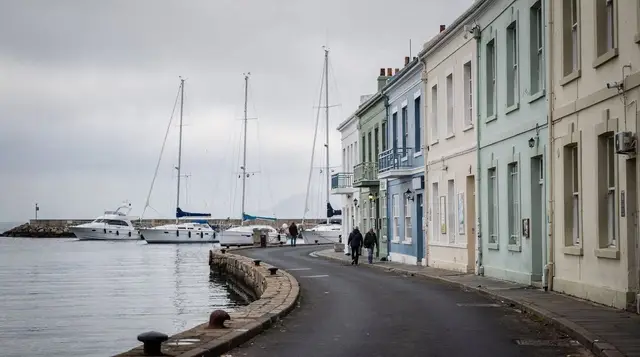
Kalk Bay is a small fishing village on the False Bay coast, squeezed between the railway line and the water a short distance south of Muizenberg. It takes its name from the lime kilns (kalk is Afrikaans and Dutch for lime) that once operated here using burned seashells, and today it’s one of the more distinctive stops on the peninsula precisely because it hasn’t been polished into a purely tourist-facing village — the harbour is still a working one, and the main road is a genuine mix of fishing supply shops, antique dealers, and cafes rather than a curated strip.
| Where | False Bay coast, between Muizenberg and Fish Hoek |
| Character | Working fishing harbour with antique shops and cafes along the main road |
| Getting there | Car, or the Southern Line train (a scenic route in its own right) |
| Time needed | A few hours — it’s compact and walkable |
| Best for | Browsing, seafood, and a slower-paced coastal stop |
The harbour
Kalk Bay’s harbour is small but active, with local fishing boats still bringing in a daily catch, and it’s one of the more reliable places on the peninsula to buy fish directly off the boat if you’re self-catering or simply curious about the trade. Cape fur seals hang around the harbour more or less permanently, drawn by the fish being cleaned and sold, and they’re a genuine, unstaged feature of the place rather than an attraction laid on for visitors — keep a respectful distance, since these are wild animals used to humans but not tame ones.
The main road: antiques, books and cafes
The short main road running through Kalk Bay is dense with independent shops — antique and vintage furniture dealers, a well-regarded secondhand bookshop, art galleries, and a run of cafes and restaurants that make the most of the harbour and mountain views. It rewards browsing rather than a fixed itinerary; most visitors find they spend longer here than planned simply working through the shopfronts. Seafood restaurants along the strip serve the same catch coming off the boats a few metres away, which is about as direct a supply chain as you’ll find on this coast.
Getting here: the train is part of the experience
The Southern Line train from central Cape Town runs along the coast through Muizenberg to Kalk Bay and beyond, and the stretch alongside False Bay is one of the more scenic urban rail routes anywhere — ocean on one side, mountains on the other, for much of the journey. It’s a pleasant alternative to driving if your schedule allows for train timetables, though check current safety and service advice before relying on it, since service reliability on this line has varied over the years.
A guided cycling route along the same stretch of coast covers Kalk Bay as part of a longer ride, giving a different pace and perspective than either driving or the train.
Guided coastal cycle ride through Kalk BayHistory along the coast
Kalk Bay sits within a stretch of coastline — running through Muizenberg and St James as well — with a layered history that includes early Cape Malay fishing communities, Victorian-era seaside development, and, more recently, the area’s association with the surf and creative scenes that have grown up around it. A guided history tour covering this broader stretch of coast places Kalk Bay in that wider context rather than treating it as an isolated stop.
Muizenberg and St James coastal history tourIf you want the water too
Kalk Bay itself has a well-regarded reef break used by experienced surfers, but it’s a more technical wave than the beginner-friendly stretch at Muizenberg just up the coast, and it’s not the spot to learn on. If you want a surf lesson as part of the same coastal day, Muizenberg’s gentler beach break is the better choice, and it’s close enough to combine both stops easily.
Muizenberg surfing experienceWhat Kalk Bay isn’t
It’s worth being clear-eyed about what this stop offers: there’s no major landmark, no single must-see attraction, and no beach in the way Muizenberg or Camps Bay have one. What Kalk Bay offers instead is texture — a working harbour, a browsable strip of independent shops, and a slower pace than almost anywhere else on the False Bay coast. If you’re looking for a headline sight, this isn’t it; if you’re looking for somewhere that feels lived-in rather than curated for visitors, it’s one of the better options on the peninsula.
Boyes Drive, above the village
Climbing out of Kalk Bay towards Muizenberg, Boyes Drive is a scenic contour road that runs along the mountainside well above the railway line, giving sweeping views back down over the harbour, the coast, and False Bay itself. It’s a popular spot for an early morning or sunset walk or drive, and considerably quieter than the coastal road below — a good option if you want the view without the crowds, or if you’re looking to stretch your legs on a proper walking track (the Elephant’s Eye and Silvermine trails both connect into the same mountainside above the drive) rather than browsing shopfronts.
How this fits into a longer trip
Kalk Bay pairs naturally with Muizenberg (a few minutes further up the coast) and St James, with its small tidal pool and colourful bathing huts, making a strong half-to-full-day coastal itinerary that doesn’t require the drive out to Cape Point. It’s also a sensible lunch stop on the way to or from Simon’s Town and Boulders Beach further south.
Practical notes
Parking along Kalk Bay’s main road is limited and can be genuinely difficult to find on busy weekends, so arriving earlier in the day or using the train removes one of the more frustrating parts of a visit. Most shops and restaurants accept card, though smaller antique dealers and market-style stalls sometimes prefer cash. The harbour and main road are both easily walkable, so once you’ve parked or arrived by train, a car isn’t needed to get around the village itself.