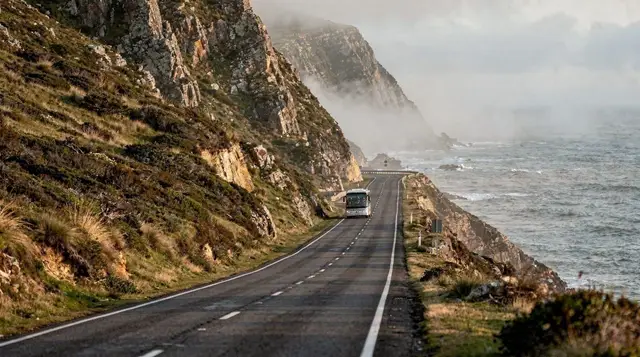
Cape Peninsula: self-drive or guided tour
Should I self-drive the Cape Peninsula or book a guided tour?
Self-driving suits visitors comfortable driving on the left on winding coastal roads who want full control over pacing and stops, and who already have or are hiring a car for the wider trip. A guided tour suits visitors without a car, uneasy about unfamiliar mountain roads or Chapman's Peak's occasional closures, or who'd simply rather have a driver and narration handle the logistics while they focus on the views.
The Cape Peninsula loop is doable either way — behind your own wheel or from the back seat of a guided tour — and there’s no single right answer. The honest comparison depends on your comfort with unfamiliar roads, how much you value flexibility over convenience, and whether you already have a car for the wider trip. Here’s what each approach actually involves.
| Self-drive | Full control over pacing and stops; requires comfort with left-hand driving on coastal roads |
| Guided tour | Driver and narration handled for you; fixed or semi-fixed schedule |
| Public transport | Not a practical option for the full loop given the distances involved |
| Key complication either way | Chapman’s Peak Drive’s toll and occasional closures |
| Best for self-drive | Visitors already hiring a car, confident on winding mountain and coastal roads |
What self-driving actually involves
Self-driving the peninsula loop means managing a hired or personal vehicle on genuinely winding roads, including the cliffside stretch of Chapman’s Peak Drive, with driving on the left required for visitors from countries where that’s not the norm. The reward is full control: linger as long as you like at Cape Point, skip a stop that doesn’t interest you, adjust the day’s order on a whim, or add a detour to Kalk Bay and Muizenberg if the day allows. It also means handling the toll on Chapman’s Peak, checking that road’s status yourself before setting off, and finding parking at busy stops like Cape Point and Boulders Beach, which can require patience during peak season.
Cape Peninsula private tour is worth considering as a middle ground — a private driver gives back much of the flexibility of self-driving without needing to handle the roads and navigation yourself.
What a guided tour actually involves
A guided tour removes the driving and navigation entirely, replacing it with a set or semi-fixed itinerary, a driver who already knows the road conditions and parking situation at each stop, and narration providing context you might otherwise miss — the history behind Simon’s Town’s naval base, the real geography behind the Cape Point two-oceans myth, what’s actually happening with Chapman’s Peak’s latest closure. The trade-off is less control over pacing: a shared group tour in particular runs to a schedule, and lingering an extra half hour at any single stop isn’t always possible.
Cape Peninsula full-day tour is the standard shared-group version of this trip, generally the most cost-effective guided option for solo travellers or small groups happy to share the day with other visitors.
Shared group versus private guided tour
Within the guided-tour option itself, there’s a further choice: a shared group tour, generally more affordable per person but running to a fixed schedule with other travellers, or a private tour, costing more but offering the flexibility to adjust stops and pacing much as a self-drive would, minus the actual driving. Families, visitors with mobility considerations, or anyone with strong preferences about which stops matter most tend to get more value from the private option.
Cape Peninsula private half-day tour suits visitors who want that flexibility but don’t need the full day — useful if the peninsula is one stop among several planned for the same day.
When self-driving makes the most sense
Self-driving is the more sensible choice for visitors who already have a hired car for the broader trip, are comfortable with left-hand driving on winding coastal and mountain roads, and want genuine flexibility over how long to spend at each stop — particularly if wildlife-watching at Boulders Beach or extended walking at Cape Point matters more to you than sticking to a set schedule. It also tends to work out more cost-effective for a family or group already sharing a hired vehicle for other days of the trip.
Cape Peninsula shared half-day tour is worth comparing directly against self-drive costs for a shorter version of the loop, if a full day feels like more time than you need.
When a guided tour makes the most sense
A guided tour is the more sensible choice for visitors without a hired car, those uneasy about unfamiliar mountain roads or the logistics of Chapman’s Peak’s toll and closures, solo travellers who’d rather not navigate alone, or anyone who simply values the narration and local knowledge a guide provides over the flexibility of doing it independently. It also removes any anxiety around finding parking at Cape Point or Boulders Beach during the busiest periods of the year.
Cape Point and Boulders Beach half-day tour from Cape Town is a practical shorter guided option if the full peninsula loop feels like more than your schedule allows.
Questions to ask yourself before you decide
A few honest questions settle most cases. Do you already have a car for the rest of the trip? If so, the peninsula is a natural extension, and the car hire guide and the notes on driving in South Africa will tell you what to expect before you collect the keys. Do you enjoy the act of driving, or does it feel like a chore between the views? Will you be travelling with someone who can share the driving and navigation, or is it all on you? And how do you feel about an itinerary that someone else sets, in exchange for not having to think about it?
If your answers lean towards “no car, no appetite for unfamiliar roads”, the decision is already made, and the better question becomes which kind of tour fits. If they lean towards “car already booked, keen to stop where the mood takes me”, self-drive is the natural fit. Anything in between points to the hybrid approach described further down.
Where the day goes: the main stops
Both options cover broadly the same ground, so it helps to know what you are choosing between. The coastal stretch from the city side leads to Hout Bay, then over Chapman’s Peak towards Noordhoek, and on to the reserve at the tip. The full picture of that headland is in the Cape Point guide, with the destination overview at Cape Point. On the way back, the False Bay side brings you through Simon’s Town, where the Simon’s Town guide is worth reading if you want to decide how long to give the town, and then the penguin colony described in the Boulders Beach penguins guide.
A self-driver chooses how long each of these gets. A guided tour makes that choice for you, usually sensibly, but it is worth checking the itinerary so that a stop you care about is not squeezed to a quick look. If penguins are the highlight for you, read where to see penguins first and pick the option that gives that stop proper time.
Weather, wind and timing
Conditions shape the day more than most visitors expect. The wind has a name locally, and the Cape Doctor guide explains why some days on the exposed headland feel very different from the city. Cloud can sit on the mountain while the coast is clear, and the reverse; the Table Mountain tablecloth guide shows how quickly that can change. A guide will often reshuffle the order of stops to suit the weather. A self-driver can do the same, but has to notice and decide in the moment.
The time of year matters too. Visitors in the warm months should read Cape Town in summer for what crowds to expect, while the quieter season is covered in Cape Town in winter. For a month-by-month view, the weather guide helps you pick the day of your trip that suits the loop best. Whenever possible, keep this loop for a clear day, because the point of the trip is the scenery.
Safety, parking and common sense on the road
Self-driving means looking after the car as well as the route. The practical advice in the Cape Town safety guide applies at viewpoints and car parks: do not leave bags or valuables visible in a parked car, and park where other people are around. A guided tour sidesteps that worry, since the vehicle is the operator’s responsibility and the driver knows which car parks feel comfortable.
Fatigue is a real factor on a long day with frequent stops and a lot of concentration on the left-hand side of the road. If you are arriving from a long flight, the notes on the first day and jet lag suggest keeping the peninsula for a day when you are rested, whichever way you travel.
Combining the loop with the rest of your trip
The peninsula rarely stands alone. Many visitors fold it into a wider plan, and the Cape Peninsula day tour guide goes deeper on the guided version, while the best day trips from Cape Town shows what else competes for your days. If your time is short, the one-day itinerary and the two-day itinerary show how little room there is to spare, and the three-day itinerary is where the peninsula starts to fit comfortably.
For visitors who prefer not to hire a car at all, the Cape Town without a car itinerary and the getting around Cape Town guide lay out the alternatives, including ride-hailing in Cape Town. Ride-hailing is fine for short city hops, but it is not a tidy answer to a loop with long, quiet stretches, which is where a tour or a private driver earns its fee.
Who tends to prefer which option
Couples who like to wander often prefer self-drive, as long as one of them is happy behind the wheel. Families with young children weigh convenience against the freedom to stop whenever someone needs a break; the Cape Town with kids guide is useful here. Solo travellers frequently choose a tour for the company and the lack of navigation, though a small private tour works well too. Visitors with limited mobility should look at the accessible travel guide before choosing, since a private vehicle with a patient driver can be easier than a busy group departure.
The one variable that matters regardless of choice
Whichever way you go, Chapman’s Peak Drive’s occasional closures are worth planning around either way — a guided tour operator will already be tracking the road’s status and adjusting the route if needed, while a self-driver needs to check this independently before setting off, and know that Ou Kaapse Weg is the standard inland alternative if the coastal route is shut on the day.
A third option: hybrid days
Some visitors split the difference across a longer trip rather than committing entirely to one approach for the whole peninsula — self-driving one day to explore at their own pace, then booking a private or shared tour on another day when they’d rather sit back and let someone else manage the logistics and narration. This works particularly well if the peninsula loop is only one of several day trips planned around Cape Town, since it lets you reserve self-driving confidence for routes you’re more familiar with and lean on a guide for the less familiar mountain roads. It’s also a sensible way to test your own comfort with local driving conditions on a shorter, lower-stakes route before committing to self-driving the full peninsula loop.
Booking considerations either way
Whichever option you choose, book ahead during peak season — both hire cars and popular tour departures can sell out on short notice during the busiest months, leaving last-minute visitors with fewer choices and higher prices. If self-driving, confirm your hire car’s insurance covers the roads you’ll actually be using, including any toll roads. If booking a tour, check what’s actually included — some itineraries bundle entry fees for stops like Boulders Beach or Cape Point into the tour price, while others leave those as separate payments on the day, which is worth knowing in advance rather than discovering at the gate.
Budget is the other thing to settle early. The Cape Town budget guide and the blog on whether Cape Town is expensive put the cost of a day like this in context, and they make it easier to compare a shared tour, a private driver and a hired car on equal terms rather than on the headline price alone. Count everything on the self-drive side: the hire itself, fuel, tolls, parking and the time you spend navigating. Count everything on the tour side too: what is included, what is extra, and whether a tip is customary, as explained in the tipping and etiquette notes.
A last practical point: whichever way you go, start early. The loop is long, light is a gift for photographs, and the busiest stops are calmer in the first part of the day. If you want ideas for where to stop for pictures, the photography spots blog is a good companion, and the overview of viewpoints will help you decide where a tour’s brief photo stop will not be enough.
tours.cape-peninsula
Verified deep-linked GetYourGuide tours. Book through these links and we earn a small commission at no cost to you.
Photos show the destination, not the operator's own images.