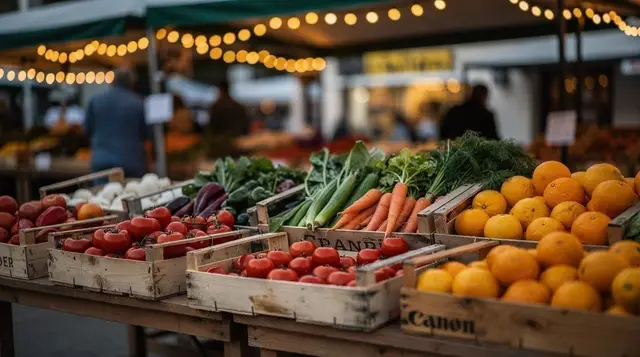
Cape Town's food markets
Are Cape Town's food markets worth prioritising over restaurants?
For a first taste of the city's food range, yes — markets let you sample multiple cuisines and traditions from a single visit, at a fraction of a formal restaurant's cost and commitment, and several of the city's better-known food traders got their start at market stalls before opening permanent kitchens. They complement rather than replace a proper sit-down meal, but they're the fastest way to get a broad sense of what Cape Town actually eats.
Cape Town’s food markets are the fastest way to get a genuine sense of the city’s food range in a single visit — a mix of Cape Malay traders, braai-style grills, international stalls, craft producers, and increasingly ambitious independent kitchens, all under one roof or in one outdoor setting. They’re also considerably more affordable and lower-commitment than working through a list of individual restaurants, which makes them a sensible way to start a food-focused day in the city rather than an optional add-on.
| What to expect | A mix of stalls covering Cape Malay, braai-style, international, and craft food |
| Cost | Generally affordable per item, easy to graze across several stalls |
| Timing | Most markets run on specific days, not daily — check before visiting |
| Best for | Sampling a broad range of Cape Town food in one outing |
Why markets are the right starting point
A restaurant commits you to one kitchen’s interpretation of a cuisine; a market lets you sample several in the course of an hour or two, at a scale and price that makes trying something unfamiliar low-risk. Several of Cape Town’s now well-regarded independent food traders and small producers built their reputations at market stalls before some went on to open permanent restaurants, which means market food here isn’t automatically a step down from a formal sit-down meal — sometimes it’s where the city’s better cooking actually started.
This local street food tour is a practical way to navigate a market with someone who already knows which stalls are worth prioritising, rather than working it out through trial and error on a first visit.
What you’ll actually find
Expect a genuine mix rather than a single theme at most markets — Cape Malay traders selling bobotie, samoosas, or koeksisters alongside braai-style grilled meats, craft coffee and baked goods, and international stalls reflecting the city’s broader diversity. The format rewards grazing: a small plate here, a pastry there, rather than committing to one large meal from a single vendor. It’s worth arriving hungry and pacing yourself across several stalls instead of filling up early.
This best street food tour with a local guide covers this grazing approach directly, moving between several stalls and vendors with commentary on what makes each one worth the stop.
Markets versus a dedicated food walk
If your interest runs specifically toward the city’s Cape Malay heritage rather than the broader market mix, a dedicated walking tour through Bo-Kaap goes deeper than a market stall typically can, since it pairs the food with the neighbourhood’s history directly. See the full Cape Town food guide for how Cape Malay cuisine fits into the wider picture.
This flavours of the Cape walking food tour takes a broader, on-foot approach across multiple neighbourhoods, useful if you want variety and walking exercise combined rather than a single fixed market venue.
Combining a market visit with a cooking class
For visitors who want to go beyond eating and actually learn how a dish is made, several experiences pair a market visit — picking ingredients, understanding what’s fresh and seasonal — with a hands-on cooking session afterwards.
This food and culture tour with a cooking class combines both halves in a single outing, a good option if a market visit alone feels too passive for how you like to experience food while travelling.
Practical tips for a market visit
Check the specific market’s operating days before planning around it — most run on set days or weekends rather than daily, and turning up on the wrong day means an empty venue. Bring cash as a backup even where card payment is common, since smaller individual stalls don’t always have reliable card facilities. And favour busier stalls with visible turnover over quiet ones with food that’s clearly been sitting out — the same commonsense rule that applies to market food anywhere.
Markets as a social scene, not just a food stop
Many of Cape Town’s markets double as informal social venues, with seating areas, sometimes live music, and a genuinely mixed crowd of residents and visitors rather than a purely tourist-facing setup. Treating a market visit as a couple of hours to spend rather than a quick in-and-out stop gets more out of the experience than rushing through it.
Cape Town food & wine tours on GetYourGuide
Verified deep-linked GetYourGuide tours. Book through these links and we earn a small commission at no cost to you.
Photos show the destination, not the operator's own images.